Introduction
Terrazzo has remained part of architecture for generations, but its longevity is not explained by history alone.
A material can be old without feeling timeless. What gives terrazzo lasting relevance is the flexibility of its visual language: fragments, contrast, movement, and variation can be interpreted in countless ways without losing their identity.
Terrazzo can feel restrained or expressive, historic or contemporary, depending on its color, fragment scale, density, and surrounding materials. That adaptability allows the aesthetic to evolve alongside architecture rather than remain attached to one particular period.
What Makes It Timeless
A timeless surface is not necessarily neutral, plain, or without personality.
It is a surface that can remain visually relevant even as furniture, colors, technology, and design preferences change around it.
Materials often achieve this through balance. They contain enough character to give a space identity, but not so much that they depend entirely on a temporary decorative trend.
Terrazzo achieves this balance by combining two different visual qualities.
The background creates continuity and order. The fragments introduce movement, texture, and individuality.
Together, they form a surface that feels composed without appearing rigid. The pattern is recognizable, but it is not dependent on exact repetition.
That distinction gives terrazzo unusual visual longevity.
Color & Fragment Scale
The architectural character of terrazzo is strongly influenced by its background color and the scale of its visible fragments.
Fine fragments generally create a quieter and more uniform surface. From a distance, the material may appear almost continuous, with subtle variation becoming visible only at closer range.
Larger fragments create stronger contrast and a more graphic presence. They make the surface feel more expressive and can become an important part of the room’s visual identity.
Color plays an equally important role.
Soft neutrals, mineral tones, and low-contrast combinations often produce a restrained architectural appearance. Stronger colors and contrasting fragments can create a more playful or decorative result.
Neither approach is inherently more timeless than the other. Longevity depends on proportion, balance, and how successfully the surface relates to the surrounding space.
A composition becomes more adaptable when its colors and fragment scale support the architecture rather than compete with it.
Irregularity & Rhythm
Terrazzo does not rely on perfect visual repetition.
Its fragments create controlled irregularity. Individual pieces vary in shape, scale, placement, and color, yet the surface still reads as a unified whole.
This creates rhythm without strict symmetry.
That quality is important because natural and enduring materials rarely appear perfectly uniform. Wood grain, stone veining, plaster, metals, and mineral surfaces all contain variation. Terrazzo belongs naturally beside them because it shares that sense of visual depth.
Irregularity also helps the eye move across the surface.
Instead of focusing on a repeating motif, the viewer experiences a broader field of movement and texture. The result feels layered and material rather than simply printed or decorated.
In terrazzo-look porcelain, the most convincing designs preserve this natural sense of variation. When the fragment distribution feels too repetitive or mechanically organized, the surface may lose some of the depth associated with traditional terrazzo.
Timeless vs. Trend-Driven
The terrazzo aesthetic is broader than any single color palette or fragment style.
Some interpretations are intentionally tied to a particular design moment. Oversized fragments, highly saturated colors, extreme contrasts, or very specific decorative combinations can create a strong contemporary statement.
These designs may be beautiful, but their identity can become closely connected to the period in which they were selected.
More timeless compositions usually rely on balance rather than novelty.
They may use natural mineral references, proportionate fragment sizes, controlled contrast, and colors that can coexist with different furnishings and finishes over time.
This does not mean timeless terrazzo must always be beige, gray, or understated. It means the surface should possess enough flexibility to support future changes in the room.
The important distinction is between terrazzo as an enduring architectural language and one particular terrazzo pattern as a temporary design expression.
Understanding that difference allows designers and homeowners to choose between a surface intended to remain quietly adaptable and one intended to make a stronger moment-specific statement.
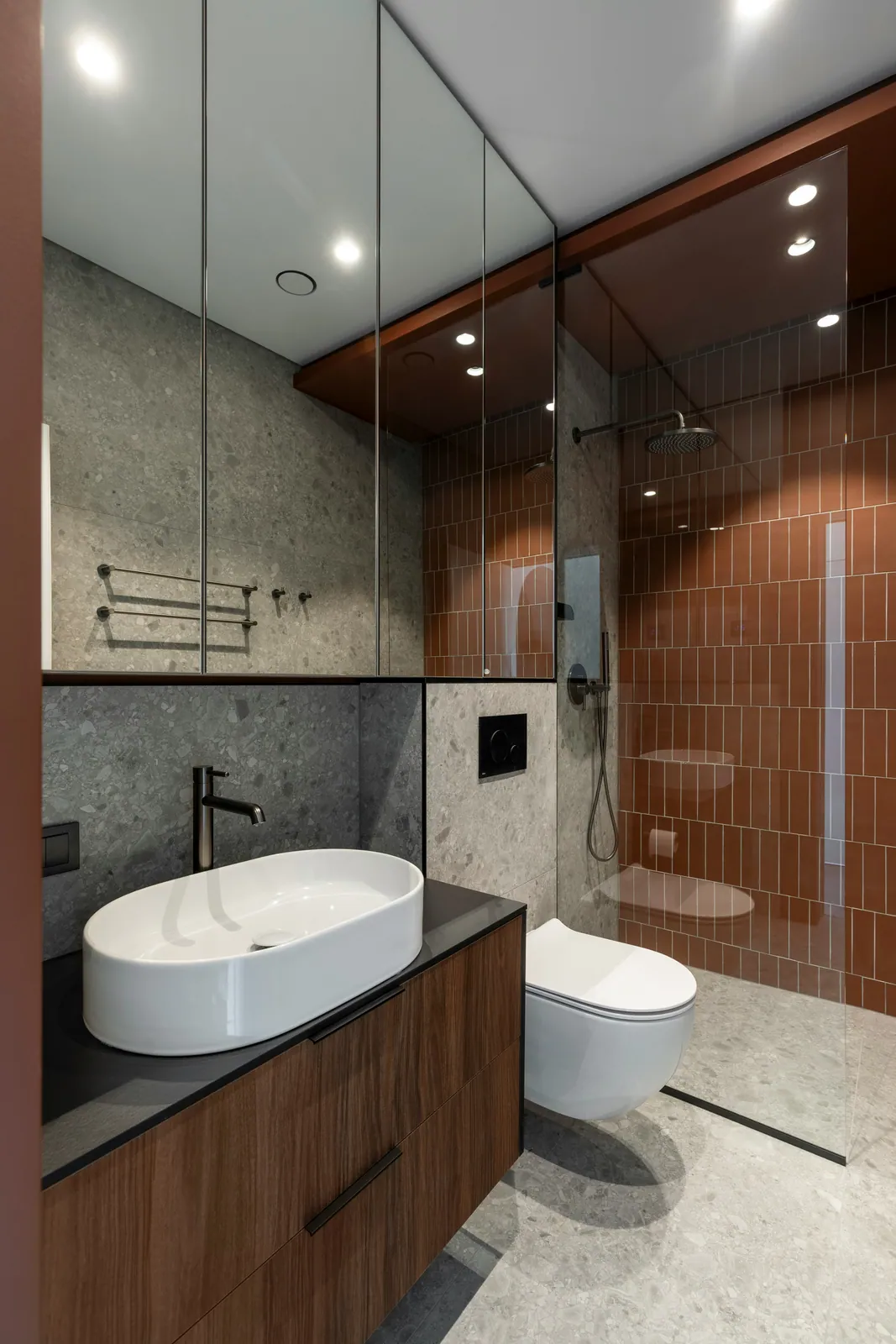
Terrazzo-look porcelain carries this visual language into a manufactured tile format. Its fragments, background tones, and visual movement are created through controlled surface design and modern production technology.
Porcelain does not reproduce the craft or construction method of poured terrazzo. Instead, it preserves and reinterprets its appearance through standardized dimensions, finishes, and installation methods.
A successful terrazzo-look porcelain surface should feel balanced at both close and distant viewing ranges. The fragment detail should provide interest without making the design appear excessively repetitive, and the overall composition should remain coherent across multiple tiles.
Conclusion
Terrazzo has a timeless architectural appearance because it is built on a flexible visual system rather than a single decorative trend.
Its combination of continuity, fragments, variation, and rhythm allows it to adapt to different periods, materials, and styles without losing its identity.
Color and fragment scale can shift. The design can become quieter or more expressive. The surrounding architecture can be traditional, modern, residential, or commercial.
Yet the essential language remains recognizable.
Terrazzo-look porcelain carries that language into a modern surface format. When its colors, proportions, and visual variation are thoughtfully selected, it can create spaces that feel current without becoming dependent on the present moment.