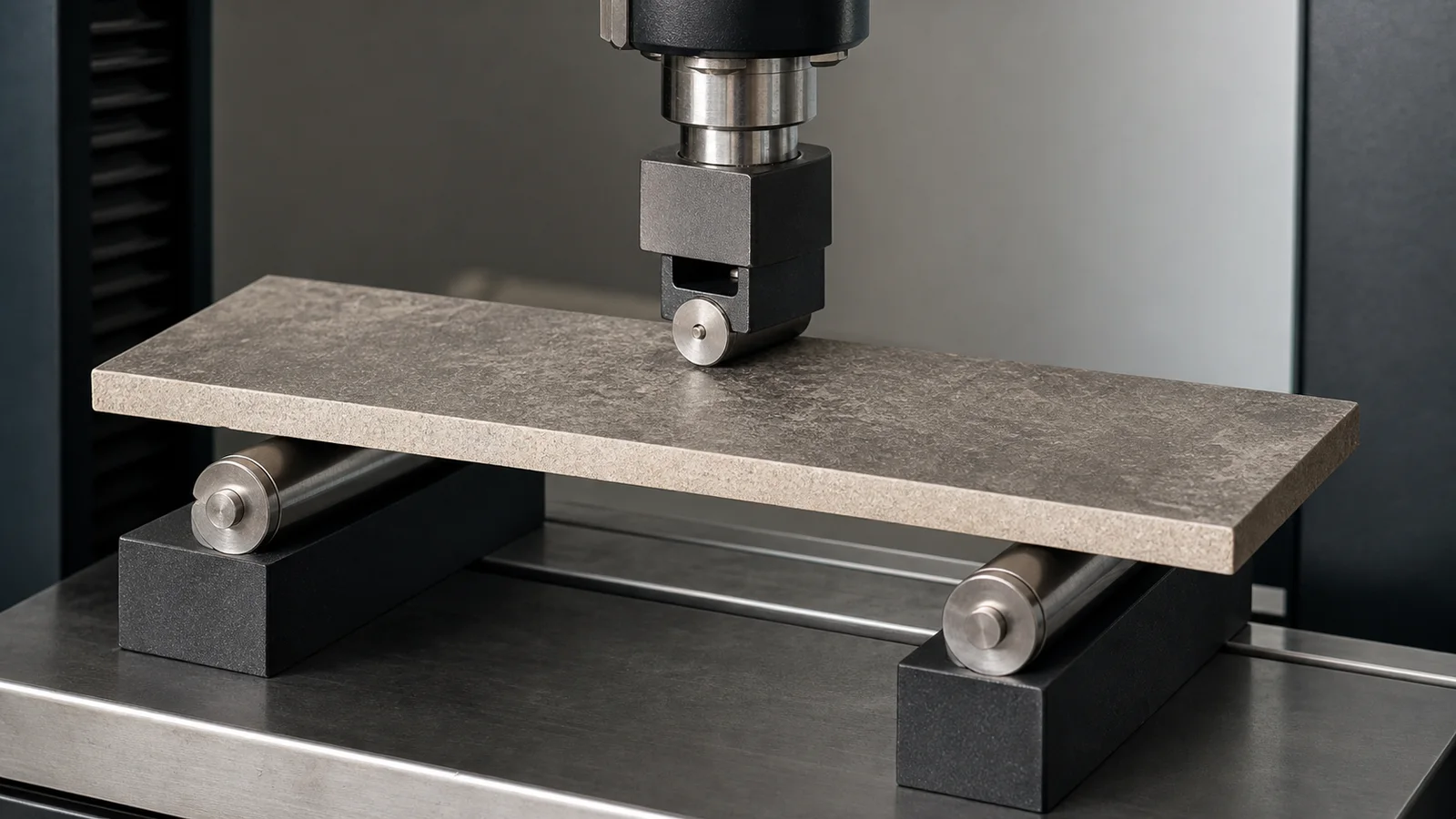
Breaking strength describes the force required to fracture a tile under a defined laboratory loading arrangement. It is useful for comparing a product with specification requirements—but it is not a prediction of the exact load an installed floor will carry.
What Breaking Strength Measures
In a controlled test, a tile specimen is supported and loaded until it breaks. The recorded force is its breaking load or breaking strength under that method. ASTM C648 defines tile strength as the force required to cause the tile to break and covers porcelain and other ceramic tile types within its scope.
The number is meaningful only with its test method, specimen geometry, units, and product information. A result from one method should not be compared casually with a result calculated under another.
How Ceramic Tile Is Tested
ISO 10545-4 specifies a method for determining modulus of rupture and breaking strength for ceramic tile. ASTM C648 covers breaking strength, while ASTM C1505 addresses breaking strength and modulus of rupture using three-point loading. In these tests, the specimen is supported near opposite sides and a load is applied in a prescribed location and manner until fracture.
Test controls matter. Support spacing, loading geometry, specimen dimensions, conditioning, rate of load, and calculation rules can affect the reported value. That is why technical sheets should state the standard rather than presenting an isolated strength number.
Breaking Strength Is Not the Same as Modulus of Rupture
Breaking strength is the force associated with fracture under the test setup. It is strongly influenced by the specimen’s dimensions, including thickness.
Modulus of rupture (MOR) is a calculated flexural stress at failure. The calculation accounts for test geometry and dimensions, making it useful for describing material behavior. Even so, MOR values remain tied to the relevant standard and specimen conditions.
Because the two quantities answer different questions, they should not be substituted for one another. A complete review identifies which value is reported, the units used, and the test method.
From Laboratory Result to Installed Performance
A tile in a bending fixture is not the same as a tile fully bonded to a properly prepared substrate. Installed performance depends heavily on continuous support and load transfer. Mortar voids, substrate movement, unevenness, inadequate curing, missing movement joints, or concentrated loads can create stresses that a product-only result does not represent.
- Product factors: body composition, firing, thickness, format, defects, and surface profile.
- Assembly factors: substrate stiffness, flatness, mortar selection, coverage, and curing.
- Design factors: expected live loads, point loads, rolling loads, impact, joints, and environmental movement.
- Execution factors: handling, cutting, edge protection, back-buttering where required, and workmanship.
For demanding commercial, industrial, exterior, pedestal, or raised-floor applications, the project team should verify both product test data and the intended assembly. System-level evaluation may also be relevant; ASTM C627, for example, evaluates ceramic floor-tile installation systems with a Robinson-type floor tester.
Common Questions
What is a good breaking-strength number for porcelain tile?
There is no single number suitable for every product and application. Use the requirement established by the applicable product specification, test method, manufacturer, and project conditions.
Does high breaking strength mean a tile cannot crack?
No. A laboratory result does not eliminate cracking risk. Insufficient support, substrate movement, impact, poor handling, or installation defects can still cause failure.
Can breaking strength values from different standards be compared directly?
Not without confirming that the test geometry, calculation, specimen dimensions, conditioning, and units are comparable. The named standard and full report provide the necessary context.
Standards Referenced
The following official scopes support this overview. Use the complete applicable standard, product specification, and manufacturer instructions for project decisions.
- ISO 10545-4:2019 — modulus of rupture and breaking strength of ceramic tile.
- ASTM C648-20 — breaking strength of ceramic tile, including porcelain tile.
- ASTM C1505-15(2022) — three-point loading for breaking strength and modulus of rupture.
- ASTM C627-18(2024) — system-level evaluation of ceramic floor-tile installations.