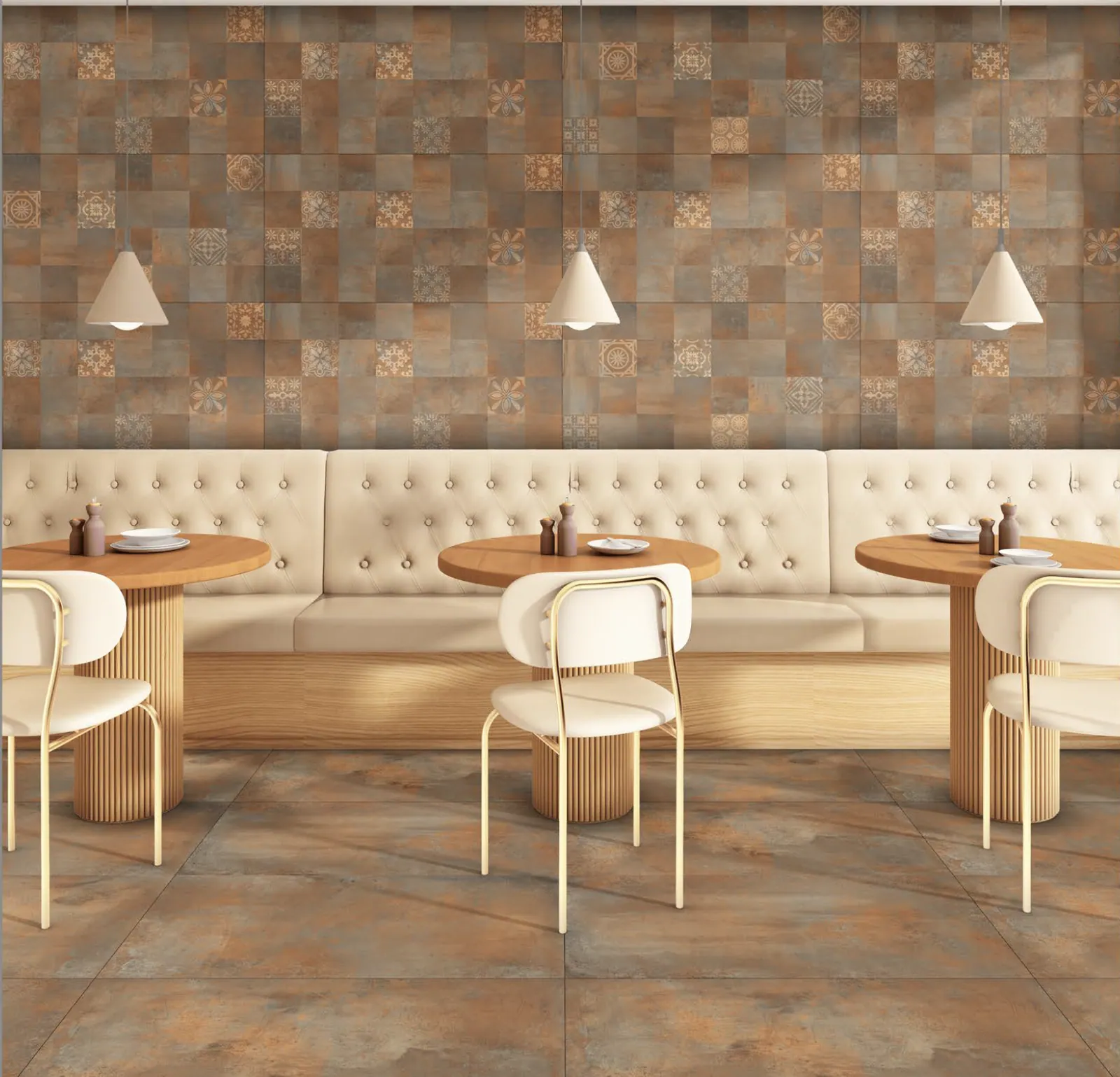
Commercial buildings place unique demands on flooring and wall surfaces. Hotels, restaurants, hospitals, schools, airports, office buildings, shopping centers, and retail stores all experience different levels of foot traffic, cleaning requirements, moisture exposure, and daily wear.
For this reason, selecting porcelain tile for a commercial project involves much more than choosing a color or design. It requires understanding how the material will perform under the specific conditions of the intended environment.
Rather than asking whether a tile is "commercial," professionals evaluate whether a particular porcelain tile is suitable for the application.
What Does "commercial" Really Mean?
Contrary to popular belief, commercial is not a type of porcelain tile.
Instead, the term describes the environment in which the tile will be installed.
A neighborhood coffee shop, a luxury hotel lobby, an airport terminal, and a hospital corridor are all commercial spaces, yet each presents completely different performance requirements.
For this reason, no single porcelain tile can accurately be described as suitable for every commercial application.
The correct choice depends on matching the product's technical characteristics to the demands of the project.
Is Every Porcelain Tile Suitable for Commercial Use?
No.
Porcelain products can have very different performance characteristics, finishes, thicknesses, and approved applications.
Some porcelain products are ideal for residential interiors.
Others are specifically engineered to withstand heavy pedestrian traffic, frequent cleaning, rolling loads, moisture, or demanding public environments.
Selecting a tile simply because it is labeled "commercial" may not always produce the best result.
The better approach is to evaluate the performance requirements of the installation itself.
What Should Be Considered When Selecting Commercial Porcelain Tile?
Professionals typically evaluate several technical characteristics before specifying porcelain tile for commercial projects.
Why Is Proper Specification So Important?
The same porcelain tile may be suitable for one environment and inappropriate for another.
For example, a boutique clothing store does not place the same demands on flooring as an airport terminal.
Likewise, a hotel bathroom has different performance requirements than a hospital corridor or a restaurant kitchen.
Successful commercial projects result from selecting materials that match the intended application rather than searching for a single product suitable for every situation.
Common Commercial Applications
Porcelain tile is widely specified for:
Maintenance
One of porcelain's greatest advantages in commercial environments is its ease of maintenance.
Routine cleaning using manufacturer-recommended procedures and pH-neutral cleaning products is generally sufficient for many installations.
Establishing an appropriate maintenance program helps preserve both the appearance and long-term performance of the surface.
What to Remember
Commercial performance is not determined by a marketing label.
It is achieved by selecting the porcelain tile whose technical characteristics best match the demands of the intended environment.
Understanding the application, evaluating the project's performance requirements, and selecting materials accordingly are the principles that guide successful commercial installations.
Common Questions
What makes porcelain suitable for commercial spaces?
Suitability depends on the exact product’s declared performance, finish, traffic, cleaning program, substrate, and installation system—not simply the word porcelain.
Is a commercial rating enough by itself?
No. The project team should review the actual application, expected loads, wet conditions, transitions, maintenance, and relevant requirements.
Can polished tile be used in an entrance?
The finish must be evaluated for the anticipated conditions, including tracked-in water and contaminants. Entrance design and maintenance also matter.
Why are movement joints important?
Tile assemblies move with buildings and environmental conditions. Movement accommodation should be designed and installed as part of the system.