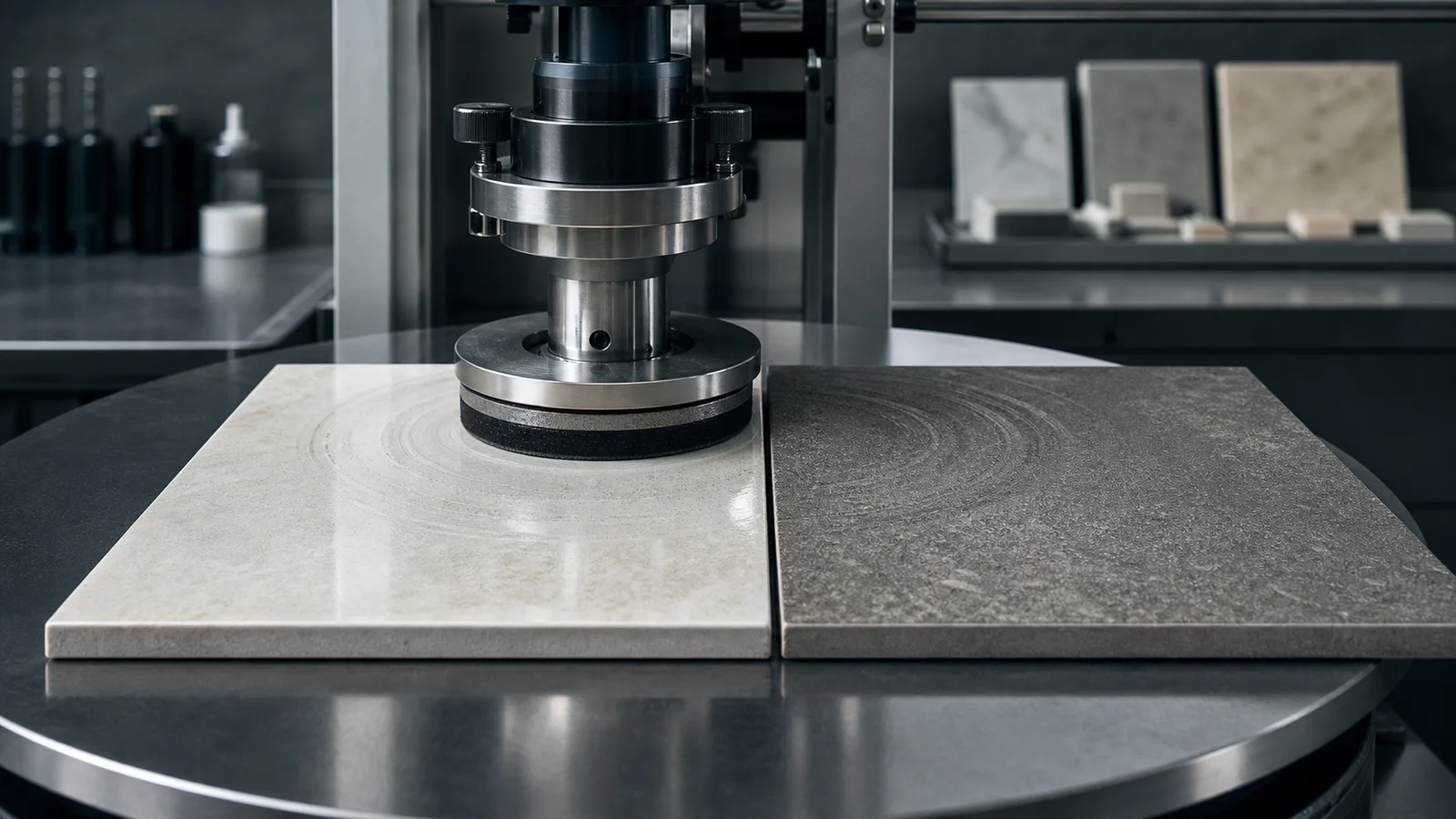
Abrasion resistance is a tile surface’s ability to withstand wear caused by foot traffic and abrasive particles. For porcelain tile, the correct evaluation depends first on whether the tested surface is glazed or unglazed.
What Abrasion Resistance Means
Walking traffic can carry sand, grit, and other particles across a floor. Over time, that action may change gloss, color, texture, or surface profile. Abrasion testing creates controlled wear so products can be classified or compared under a defined method.
Abrasion resistance is not the same as scratch hardness, breaking strength, slip resistance, or stain resistance. Each characteristic has a different test and answers a different performance question.
Visible Abrasion of Glazed Tile
For glazed ceramic floor tile, ISO 10545-7 determines resistance to surface abrasion, and ASTM C1027 measures resistance to visible surface abrasion. The surface is exposed to an abrasive load for prescribed cycles and then assessed for a visible change under controlled viewing conditions.
These methods focus on when wear becomes visible. Color, pattern, gloss, texture, and visual contrast can influence how readily a change is detected. ASTM C1027 specifically notes that it is intended to compare tiles of like color and finish and does not optimally evaluate loss of gloss.
Market literature often uses “PEI rating” as shorthand for glazed-tile wear classification. Because labels and reporting practices vary, the safer approach is to request the actual classification, named test standard, and manufacturer’s recommended traffic category.
Deep Abrasion of Unglazed Tile
Unglazed tile exposes the ceramic body itself, so wear is evaluated differently. ISO 10545-6 determines resistance to deep abrasion for unglazed floor tile by measuring material removed under a prescribed abrasive action.
ASTM provides related methods for unglazed ceramic tile. ASTM C501 establishes an abrasive wear index from weight loss using a Taber Abraser, while ASTM C1243 measures relative resistance to deep abrasive wear using a rotating disc. The reported values and units are method-specific and should not be mixed.
Selecting Porcelain Tile for Expected Traffic
The intended environment matters as much as the laboratory result. A quiet residential bathroom, a retail entrance, a restaurant, and a transit space expose floors to different traffic volumes, contaminants, cleaning routines, and appearance expectations.
- Identify whether the wear surface is glazed or unglazed.
- Ask for the named test method, classification or value, and current technical sheet.
- Match the manufacturer’s recommended use to the expected traffic and maintenance program.
- Consider entrances separately because tracked-in grit can accelerate wear.
- Use mats, effective cleaning, and grit control as part of the floor’s performance plan.
- Review slip resistance independently; a wear classification does not establish traction.
No tile remains visually unchanged under every condition. Good specification aligns the surface, traffic, cleaning process, and acceptable appearance over the service life.
Common Questions
Is abrasion resistance the same as scratch resistance?
No. Abrasion addresses progressive wear from repeated abrasive action, while scratch resistance concerns damage from a more localized contact. They require different evaluations.
Does every porcelain tile have a PEI rating?
No. The commonly used PEI terminology relates to visible abrasion classification of glazed surfaces. Unglazed products use different deep-abrasion or wear methods, and manufacturers may report results under different standards.
Can a high abrasion rating replace slip-resistance data?
No. Abrasion and slip resistance measure different characteristics. A floor specification should review each relevant property independently.
Standards Referenced
This overview distinguishes the official test scopes below. Consult the full current standards and the product manufacturer for a project specification.
- ISO 10545-7:1996 — surface abrasion resistance of glazed ceramic floor tile.
- ISO 10545-6:2010 — deep abrasion resistance of unglazed ceramic floor tile.
- ASTM C1027-19 — visible abrasion resistance of glazed ceramic tile.
- ASTM C501-21 — relative wear resistance of unglazed ceramic tile using the Taber Abraser.
- ASTM C1243-23 — relative deep abrasive wear of unglazed ceramic tile by rotating disc.