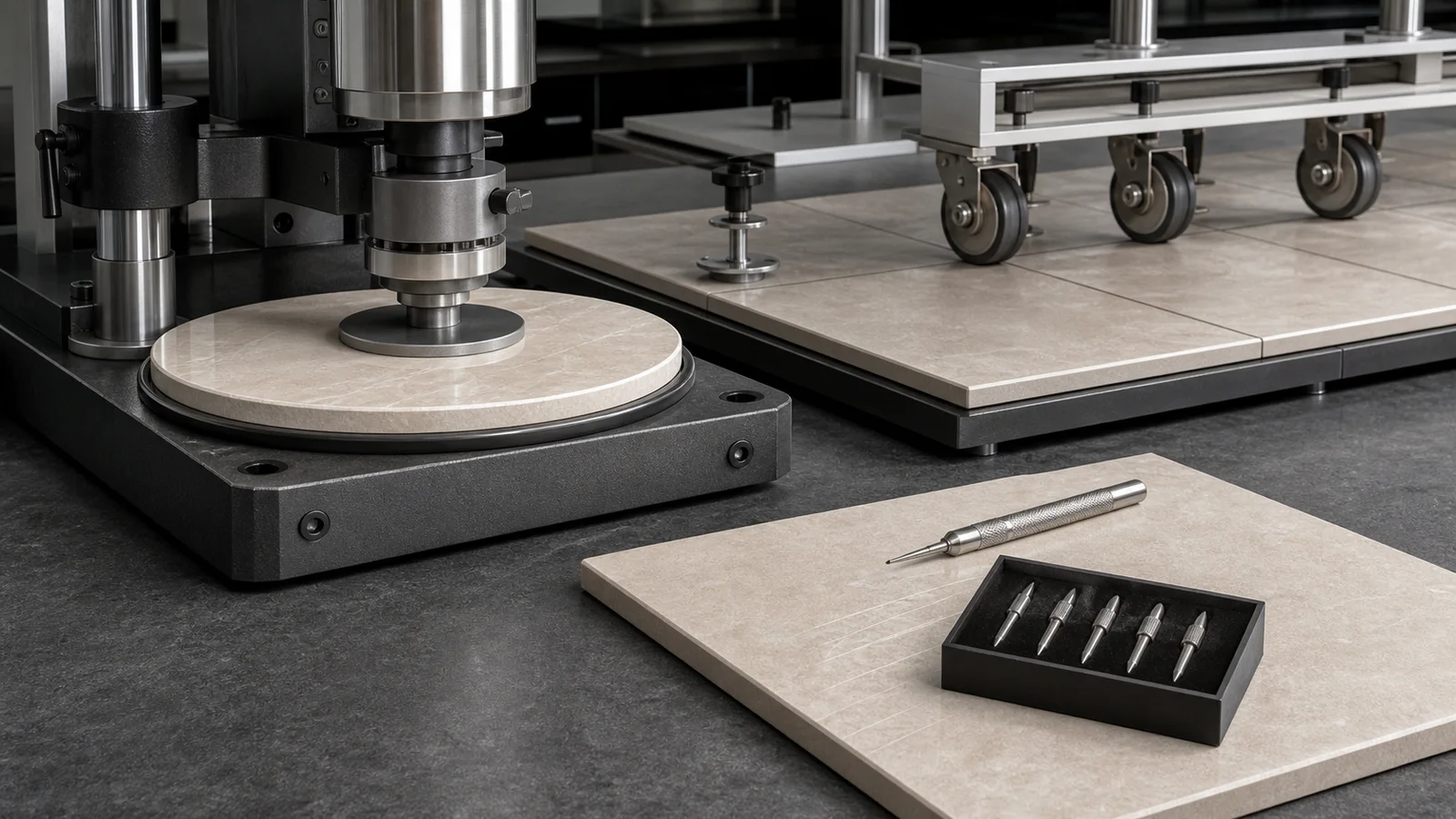
PEI classification, scratch resistance, and traffic suitability describe different aspects of porcelain tile performance. None of them can replace the others, and no single rating proves that a tile is suitable for every floor.
Three Different Questions
| Customer question | Relevant property | What it evaluates |
|---|---|---|
| Will foot traffic visibly wear the glaze? | Visible abrasion classification, often called PEI | When wear becomes visible on a glazed surface under a standardized abrasive cycle |
| Can a pointed material scratch the surface? | Scratch hardness | Resistance to a localized scratch from a pick or material of known hardness |
| Will the floor perform in this traffic condition? | Application and system suitability | Product wear plus substrate, installation, loads, contaminants, maintenance, and appearance expectations |
The terms overlap in everyday conversation because traffic can introduce abrasive particles and scratches. Technically, however, they use different test methods and answer different questions.
What Does “PEI Rating” Mean?
In the tile market, PEI rating commonly refers to the visible-abrasion classification of a glazed ceramic tile. The name is historically associated with the Porcelain Enamel Institute, but current technical documentation should identify the actual test standard and classification.
ISO 10545-7 evaluates surface-abrasion resistance of glazed floor tile. ASTM C1027 measures resistance to visible surface abrasion by rotating an abrasive load over the surface and visually comparing tested specimens with unabraded tile.
The test is about when a visible change appears. Color, pattern, gloss, texture, and contrast influence how easily wear can be detected. ASTM C1027 therefore limits comparison to tiles of like color and finish and notes that the method does not optimally evaluate loss of gloss.
How PEI Classes Are Commonly Interpreted
| Class | General market interpretation | Important caution |
|---|---|---|
| 0 | Not recommended for floor traffic | May be intended for walls or decorative use |
| 1 | Very light residential floor exposure | Conditions with abrasive dirt may exceed the recommendation |
| 2 | Light residential traffic | Verify the rooms and footwear conditions listed by the manufacturer |
| 3 | General residential or selected light commercial use | Application recommendations vary by product and standard |
| 4 | Heavier residential and many commercial conditions | Entrances and abrasive grit still require specific review |
| 5 | Severe pedestrian traffic under the applicable classification | Does not establish scratch-proof, impact-proof, or structural performance |
This table is a general orientation, not a project specification. Use the maximum recommended application declared for the exact product under its applicable standard. Similar-looking finishes in one collection may have different classifications.
Why PEI Does Not Apply to Every Porcelain Tile
Visible-abrasion classification is intended for glazed surfaces. Unglazed or through-body porcelain exposes the ceramic body itself and is evaluated using deep-abrasion or material-loss methods. Asking for a PEI class on an unglazed product can therefore produce an irrelevant or misleading answer.
What Is Scratch Resistance?
Scratch resistance concerns localized damage caused when a harder object moves across a surface. ASTM C1895-26 provides a Mohs scratch-hardness procedure for ceramic tile, glass tile, and other hard surfaces using picks of known hardness and visual observation of the attempted scratch.
The Mohs scale is ordinal, not linear. The numerical difference between adjacent levels does not represent an equal increase in resistance. A reported value must also belong to the exact surface—glaze, polish, protective layer, or exposed body—not simply to “porcelain” as a generic material.
- Abrasion is progressive wear from repeated contact and abrasive particles.
- Scratching is a more localized mark or groove caused by a harder contact.
- Impact is sudden loading from a falling or striking object.
- Breaking strength is the force required to fracture a tile under a defined laboratory setup.
A surface can perform well in one category and differently in another. A high visible-abrasion class does not make a glazed surface immune to scratching from metal, minerals, construction debris, or dragged furniture.
How Unglazed Porcelain Wear Is Tested
ISO 10545-6 evaluates deep abrasion of unglazed floor tile. ASTM C1243 measures volume loss caused by a rotating disc and abrasive material. ASTM C501 provides an alternative unglazed-tile wear method using a Taber Abraser and weight loss.
These results are method-specific. A lower material-loss value under one deep-abrasion method cannot be converted informally into a PEI class, a Mohs value, or another test’s scale.
What Does “Traffic Resistance” Actually Mean?
Traffic resistance is useful customer language, but it is not one universal tile rating. A complete decision considers how the surface wears and how the installed assembly carries expected use.
- Pedestrian volume: occasional residential use differs from continuous retail, hospitality, institutional, or transit traffic.
- Abrasive contamination: sand and grit at entrances can be more damaging than clean indoor foot traffic.
- Rolling loads: carts, equipment, hard wheels, and concentrated loads affect the complete assembly.
- Surface visibility: dark, glossy, plain, or strongly illuminated finishes may show change sooner.
- Installation: substrate stiffness, mortar coverage, joints, movement accommodation, and workmanship transfer loads.
- Maintenance: entrance mats, grit removal, cleaning chemistry, and equipment influence long-term appearance.
ASTM C627 evaluates complete ceramic floor-tile installation systems under dynamic loads using a Robinson-type floor tester. The standard explicitly distinguishes system evaluation from individual properties such as abrasion resistance. ASTM C648, by comparison, evaluates tile breaking strength as a product test.
A Practical Customer Selection Method
- Identify the surface: glazed, unglazed, through-body, polished, matte, textured, or another finish.
- Define the traffic: residential, commercial, entrance, rolling equipment, abrasive grit, footwear, and cleaning frequency.
- Ask the right test: visible abrasion for glazed tile, deep abrasion for unglazed tile, and scratch hardness when scratching is a concern.
- Review strength separately: verify breaking-strength or modulus-of-rupture information and the intended installation system.
- Confirm manufacturer use: obtain the maximum recommended application for the exact color, finish, format, and thickness.
- Plan protection: use entrance mats, remove grit, protect the floor during construction, and avoid dragging hard objects.
For a deeper explanation of glazed and unglazed wear tests, read What Does Abrasion Resistance Mean in Porcelain Tile? →
Common Questions
Is PEI 5 porcelain tile scratch-proof?
No. PEI Class 5 concerns visible abrasion of a glazed surface under its test method. Scratch resistance is a separate property evaluated using a different method.
What PEI rating is best for commercial traffic?
There is no universal answer for every commercial space. Review the exact product’s maximum recommended use, expected grit and traffic, finish, maintenance, rolling loads, and complete installation system.
Does unglazed porcelain tile have a PEI rating?
PEI terminology applies to visible abrasion classification of glazed surfaces. Unglazed floor tile is evaluated using deep-abrasion or material-loss methods such as ISO 10545-6 or ASTM C1243.
Is Mohs hardness the same as PEI?
No. Mohs scratch hardness concerns resistance to scratching by a harder point, while PEI terminology concerns progressive visible abrasion of a glazed surface.
Can high-traffic porcelain tile still crack?
Yes. Surface-wear suitability does not prevent failure caused by impact, inadequate support, substrate movement, missing movement joints, poor mortar coverage, or unsuitable assembly design.
Why do two PEI 4 tiles show wear differently?
Color, gloss, pattern, texture, contrast, contaminants, lighting, and maintenance affect how visible change appears. Confirm the exact test classification and manufacturer recommendation for each product.
Standards and Sources Referenced
This article summarizes the public scopes below. Product selection should use the complete current standards, manufacturer documentation, and project requirements.
- ISO 10545-7:1996 — surface-abrasion resistance of glazed ceramic floor tile.
- ASTM C1027-19 — visible abrasion resistance of glazed ceramic tile.
- ISO 10545-6:2010 — deep-abrasion resistance of unglazed ceramic floor tile.
- ASTM C1243-23 — relative deep abrasive wear of unglazed ceramic tile.
- ASTM C1895-26 — Mohs scratch hardness of ceramic tile and other hard surfaces.
- ASTM C627-18(2024) — dynamic-load evaluation of complete ceramic floor-tile installation systems.
- ASTM C648-20 — breaking strength of ceramic tile.