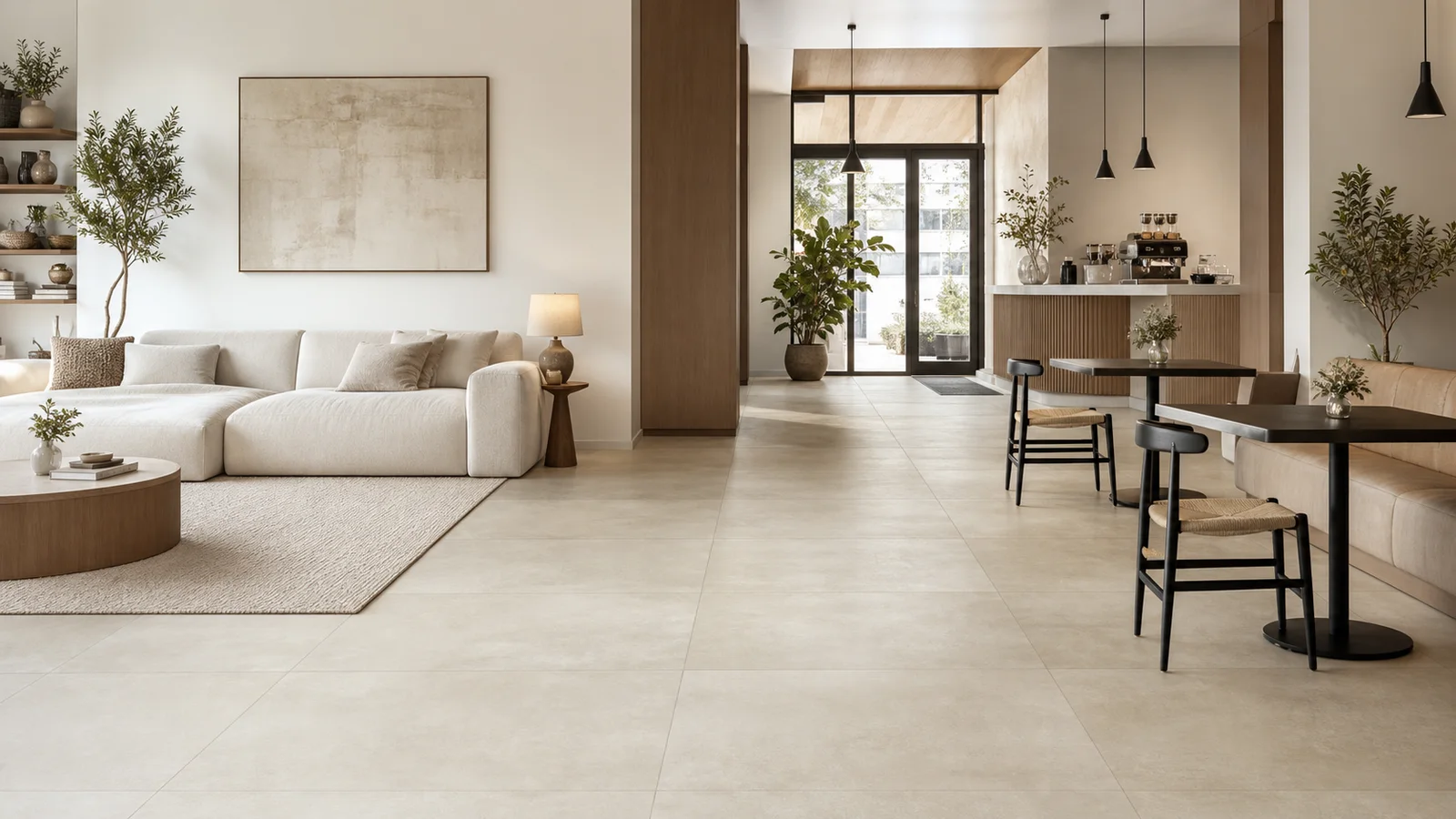
Residential and commercial tile are not always two different products. The words usually tell you where the manufacturer recommends using a particular tile and finish. Some porcelain tiles are approved for homes only, while many are suitable for both homes and businesses.
What Is the Simple Difference?
| Home use usually means | Commercial use may add |
|---|---|
| Fewer people and shorter traffic periods | Many people throughout the day |
| Less dirt and sand entering from outside | More abrasive grit near entrances |
| Household cleaning products | Frequent cleaning and stronger chemicals |
| Furniture and normal home loads | Carts, equipment, hard wheels, or concentrated loads |
| Private kitchens and bathrooms | Public wet areas, food service, or regulated spaces |
A quiet office and a busy airport are both “commercial,” but their demands are very different. That is why the word commercial is only a starting point.
A busy home can also create demanding traffic. Continue with How to Choose Porcelain Tile for High-Traffic Areas →
What Does “Commercial Grade” Mean?
It is useful sales language, but it is not one universal porcelain-tile rating. Ask what evidence supports the claim.
For glazed tile, visible abrasion testing helps describe how the surface responds to wear. Unglazed tile uses different abrasion methods. A complete floor system may also be evaluated under moving loads. None of these individual results means a tile is automatically right for every business.
Confused by PEI or traffic ratings? Read What Do PEI, Scratch Resistance, and Traffic Ratings Mean? →
Five Things to Check Before Buying
- Approved use: Does the manufacturer list your exact type of space?
- Traffic and dirt: Is it a quiet bedroom, busy entry, store, restaurant, or public lobby?
- Wet conditions: Will water, grease, or other contaminants reach the floor?
- Cleaning: How often will it be cleaned, and with which products or machines?
- Complete installation: Can the substrate, mortar, grout, joints, and installer support the expected use?
Common Buying Situations
| Situation | Simple advice |
|---|---|
| Using commercial tile at home | Usually possible. Make sure the finish feels comfortable, is easy to maintain, and suits the room. |
| Using residential tile in a store | Do not assume. Ask for written approval for the expected traffic and entrance conditions. |
| Rental or busy family home | Consider it a demanding residential use and prioritize wear, stains, cleaning, and replacement availability. |
| Small office or boutique | Light commercial may be enough, but entries and rolling chairs can create special demands. |
| Restaurant or commercial kitchen | Needs project-specific review for grease, wet slip, chemicals, cleaning, equipment, codes, and the full floor system. |
The Six-Question Buyer Checklist
- Is this exact tile and finish approved for my space?
- Is the recommendation for a wall, floor, wet area, or exterior?
- What kind of traffic and dirt should I expect?
- Are carts, rolling chairs, equipment, or heavy loads involved?
- Which cleaning products and maintenance does the tile require?
- Does the warranty cover my intended application and installation system?
If the seller or manufacturer cannot answer these questions in writing, keep looking.
Common Questions
What is the difference between residential and commercial tile?
The label generally describes the traffic and conditions for which the exact tile is recommended. It does not necessarily identify a different material or manufacturing category.
Can commercial porcelain tile be used in a home?
Usually yes, if the finish, appearance, maintenance, slip behavior, installation requirements, and intended room are suitable.
Can residential tile be used in a commercial space?
Only when the manufacturer approves the exact tile and finish for that application and the complete installation meets the project requirements.
Does commercial grade mean the tile cannot scratch or break?
No. Commercial suitability does not mean scratch-proof, stain-proof, slip-proof, or unbreakable.
Is PEI the same as a commercial rating?
No. PEI terminology commonly concerns visible abrasion of glazed tile. Commercial suitability also depends on the use, contaminants, maintenance, loads, and complete installation.
What should I ask before buying tile for a business?
Ask for written approval for the exact business use, traffic, wet or dry conditions, finish, cleaning chemicals, rolling loads, installation method, and warranty.