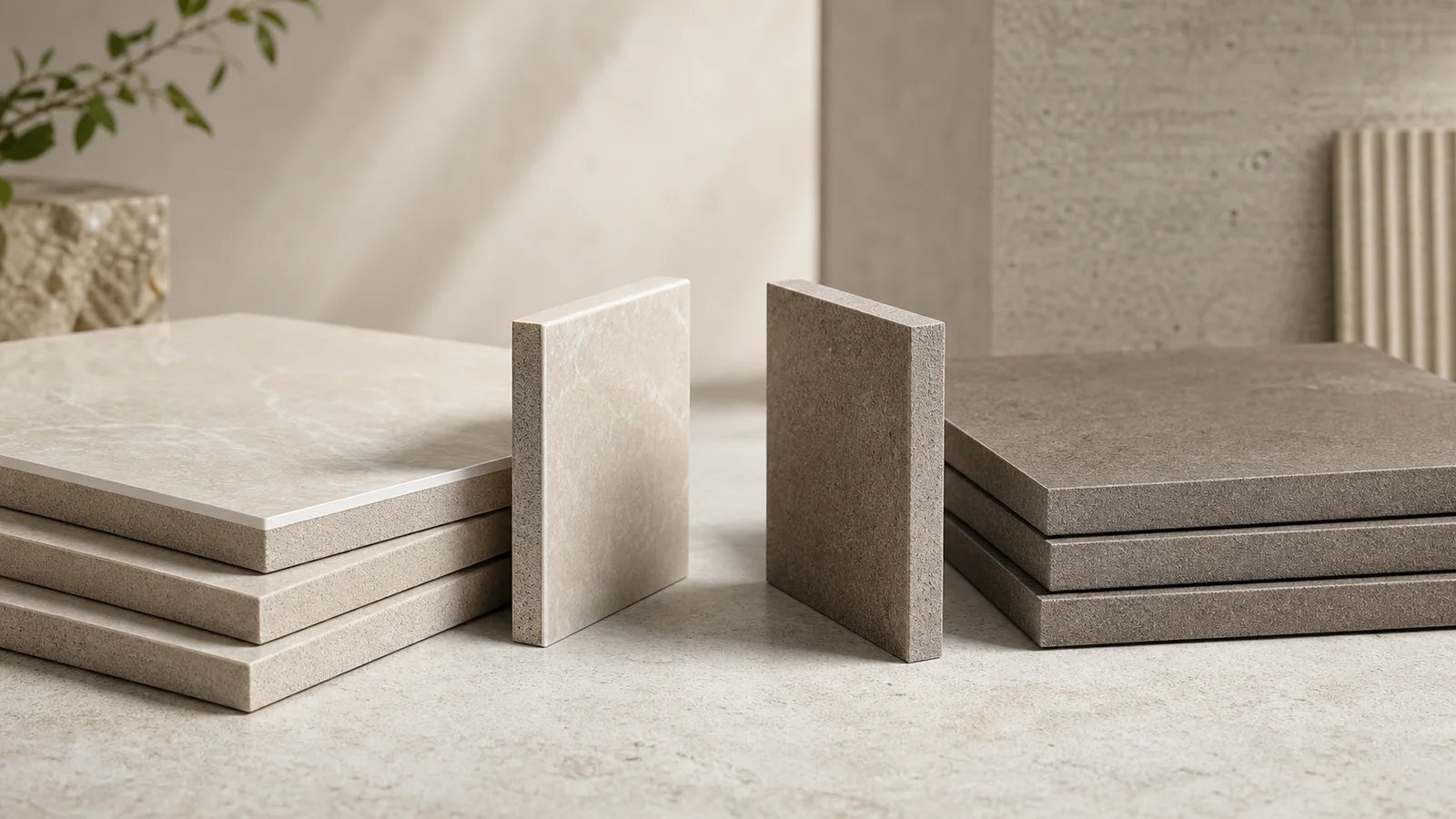
Glazed porcelain tile has a distinct fired surface layer that can provide color, pattern, texture, and performance characteristics different from the body beneath it. Unglazed porcelain tile exposes the ceramic body itself as the wearing surface. Both can be technically excellent; the better choice depends on the exact product and application.
The Essential Construction Difference
A glaze is a ceramic surface coating fused to the tile during firing. Modern decoration can combine glazes, inks, effects, and textures to create stone, marble, wood, concrete, metallic, patterned, or solid-color appearances.
In an unglazed porcelain tile, the body composition itself forms the visible wearing surface. Pigments and granules may be distributed through the body to create a uniform color or more complex through-body appearance.
| Characteristic | Glazed porcelain | Unglazed porcelain |
|---|---|---|
| Visible surface | A distinct fired decorative or functional surface layer | The tile body itself |
| Design range | Can reproduce highly varied graphics, colors, gloss levels, and textures | Appearance is produced by body materials, pigments, granules, and finishing processes |
| Wear evaluation | Visible surface-abrasion method for glazed floor tile | Deep-abrasion or material-loss method for unglazed floor tile |
| Edge and chip appearance | The body may contrast with the decorated surface | Body color or pattern may make minor wear less visually contrasting |
| Maintenance | Often easy to clean, but finish and texture control the real behavior | Dense surfaces can be easy to maintain; polished or textured products may require specific procedures |
Through-Body, Full-Body, and Color-Body Porcelain
These phrases are common, but they are not always used identically across manufacturers. The technical sheet and a physical cross-section are more reliable than the marketing name.
- Through-body porcelain commonly refers to unglazed porcelain whose visible color or design continues through the body.
- Full-body porcelain is often used similarly, but the degree of pattern continuity can vary by product.
- Color-body porcelain generally indicates a body color selected to coordinate with the decorated surface. It may still be glazed, and the body does not necessarily reproduce the surface graphic.
- Double-loaded porcelain typically uses a decorative upper body layer over a base body; it should not automatically be assumed to be visually identical through the full thickness.
For exposed edges, steps, countertops, grooves, or areas where chipping visibility is important, inspect a cut sample. A coordinated body can reduce contrast, but it does not prove that the tile is unglazed or that the graphic continues completely through it.
Why Glazed and Unglazed Tiles Use Different Wear Tests
Glazed and unglazed surfaces do not wear in the same way, so standards evaluate them differently.
Glazed floor tile: ISO 10545-7 determines resistance to surface abrasion for glazed ceramic floor tile. ASTM C1027 evaluates when visible change appears after abrasive exposure. The result concerns the glazed surface and is commonly discussed through visible-abrasion classes.
Unglazed floor tile: ISO 10545-6 determines resistance to deep abrasion for unglazed floor tile. ASTM C1243 evaluates relative deep abrasive wear using material loss produced by a rotating disc and abrasive media.
For the complete distinction, read What Does Abrasion Resistance Mean in Porcelain Tile? →
How Do Their Performance Characteristics Compare?
Stains and Cleaning
A sound glaze can provide a continuous, easily cleaned surface. Dense unglazed porcelain can also be highly stain resistant. Texture, polishing, microscopic surface openings, residues, grout, contaminants, and maintenance methods may matter more than the glazed/unglazed label.
ASTM C1378 and ISO 10545-14 provide standardized approaches to stain resistance. Request results for the exact finish because polishing or texturing can change surface behavior within one collection.
Scratches and Visible Wear
Unglazed through-body material can make deep wear or small chips less contrasting, especially when the body closely matches the face. That does not make it scratch-proof. Glazed products vary widely: some decorative surfaces are intended for walls, while others are classified for demanding floor traffic.
Scratch hardness, visible abrasion, deep abrasion, impact, and breaking strength are separate properties. A high result in one does not guarantee high performance in all the others.
Slip Resistance
Neither construction is inherently slip resistant. A textured unglazed tile may provide useful traction, while a polished unglazed tile may be smooth. A glazed tile may be glossy, matte, structured, or engineered for wet-area traction. Compare the exact finish’s current test data and declared application.
Sealing
Porcelain’s low water absorption does not answer every surface-maintenance question. Many dense unglazed products do not require sealing, while some polished or specially processed surfaces may have manufacturer-specific pre-grout, stain-protection, or maintenance instructions. A glazed face is generally not treated with a penetrating sealer, although grout and exposed edges may require separate decisions.
Never apply sealer automatically. Follow the tile and sealer manufacturers’ instructions and test in an inconspicuous area first.
Exterior and Freeze-Thaw Use
Glazed versus unglazed does not by itself establish exterior suitability. Verify freeze-thaw performance, water absorption, wet slip behavior, surface drainage, climate exposure, installation system, and the manufacturer’s approved areas of use for the exact product.
How Should You Choose?
| Project priority | What to evaluate |
|---|---|
| Highly detailed marble, wood, or decorative graphic | Glazed porcelain often offers the broadest visual range; verify abrasion class for floor use |
| Heavy wear where appearance through the body matters | Review unglazed or through-body options and their deep-abrasion data |
| Exposed fabricated edges | Inspect a cut cross-section and confirm whether the body coordinates with the face |
| Wet or exterior application | Compare exact slip and application data—not the glazed/unglazed category alone |
| Stain-sensitive environment | Request stain and chemical-resistance results for the exact surface finish |
| Low-maintenance objective | Review texture, cleaning instructions, grout, sealing guidance, and expected contaminants |
A Practical Buying Checklist
- Confirm whether the exact SKU is glazed or unglazed. Do not generalize from the collection name.
- Ask how the body is constructed. Clarify through-body, full-body, color-body, and double-loaded terminology.
- Review a cut sample. Compare the face, body, edge, and expected appearance of chips or fabrication.
- Request the correct wear result. Surface abrasion applies to glazed tile; deep abrasion applies to unglazed tile.
- Check the exact finish. Matte, polished, textured, and grip surfaces within one series can perform differently.
- Verify the approved application. Confirm walls, floors, wet areas, exteriors, commercial traffic, and cleaning conditions.
- Read maintenance and sealing instructions. Polished or textured surfaces may need procedures different from other finishes.
- Coordinate installation materials. Mortar, grout, movement joints, substrate, and workmanship remain essential for either type.
Common Questions
Is glazed porcelain tile less durable than unglazed porcelain?
Not necessarily. Durability depends on the exact glaze, body, finish, tested wear classification, application, maintenance, and installation. Many glazed products are suitable for demanding floors.
Does unglazed porcelain tile need to be sealed?
Not automatically. Dense unglazed porcelain may not require a penetrating sealer, but polished or specially finished products can have different manufacturer requirements. Follow the exact product documentation and test first.
Is through-body porcelain always unglazed?
Through-body commonly describes unglazed porcelain whose visible color or pattern continues through the body. Related marketing terms vary, so verify the technical description and inspect a cut sample.
Does glazed porcelain tile scratch easily?
There is no universal answer. Scratch resistance varies by glaze, finish, texture, and contaminant. Abrasion classification and scratch hardness are different properties.
Is unglazed porcelain more slip resistant?
Not by definition. Slip behavior depends on the exact texture and finish, contaminants, cleaning, footwear, and application. Compare current test data for the exact product.
Can glazed porcelain tile be used commercially?
Yes, when the exact product is classified and recommended for the expected traffic, contaminants, cleaning program, and installation conditions.