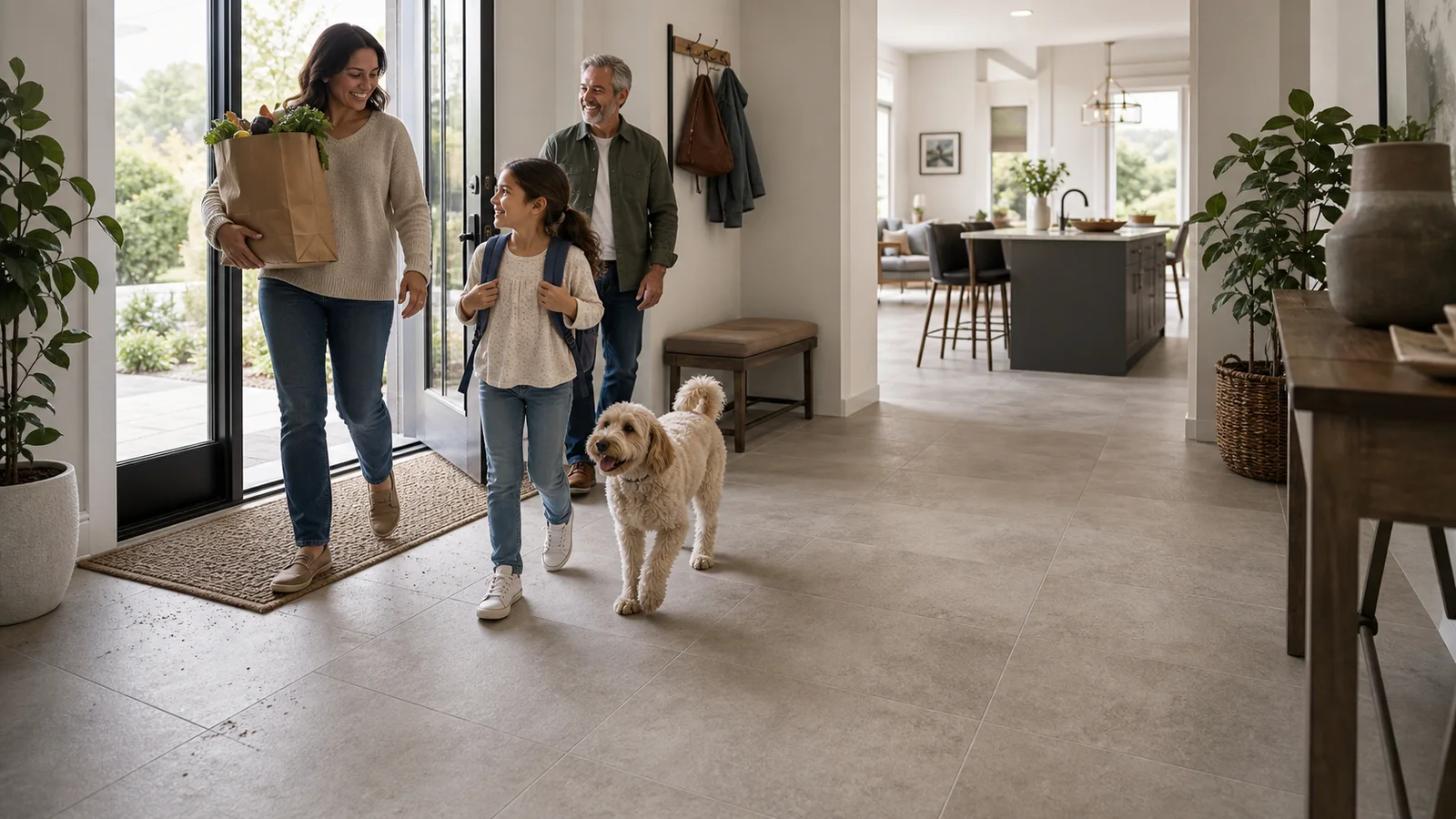
High traffic is not determined by the words “residential” or “commercial.” A family entry with children, pets, shoes, and outdoor grit may challenge a floor more than a quiet private office. Start with what will actually happen in the space.
What Does “High Traffic” Really Mean?
Traffic includes how many people use a floor, but frequency is only part of the story. Sand and grit carried through an exterior door can act like an abrasive. Wet shoes change walking conditions. A rolling cart, office chair, or heavy appliance creates different demands than ordinary footsteps.
This is why there is no single “high-traffic number” that answers every project question.
Residential vs. Commercial Is Only the Beginning
| Space | What may make it demanding |
|---|---|
| Home entry or mudroom | Outdoor grit, wet shoes, pets, strollers, and repeated daily routes |
| Kitchen and main hallway | Long periods of use, spills, chairs, cleaning, and concentrated pathways |
| Rental or busy family home | More occupants, pets, frequent move-ins, and uncertain maintenance |
| Quiet office or boutique | Lower volume, but entrances and rolling chairs still deserve attention |
| Restaurant, shop, or public lobby | Continuous traffic, abrasive soil, spills, cleaning chemicals, carts, or equipment |
First decide how the space will be used in Residential vs. Commercial Porcelain Tile →, then use this guide to evaluate its real traffic conditions.
Six Things to Compare
- Approved application: Is the exact tile and finish recommended for your type of floor and traffic?
- Surface wear: For glazed tile, ask whether its visible abrasion classification suits the expected use.
- Dirt and scratches: Consider exterior access, sand, pets, furniture, and maintenance—not only a hardness number.
- Wet conditions: Choose for the contaminants and walking conditions that will actually occur.
- Cleaning and stains: Confirm which products, methods, and frequency the surface can handle.
- Complete installation: The substrate, mortar, coverage, grout, movement joints, and installer matter too.
Need help separating PEI, scratching, and traffic claims? Read PEI, Scratch Resistance & Traffic Ratings →
Simple Room-by-Room Guidance
- Exterior entry: prioritize approved wear, wet conditions, easy cleaning, and a good mat system.
- Kitchen: consider spills, stains, dropped objects, standing comfort, and frequent cleaning.
- Hallway: look at the repeated path between doors and main rooms, not only total room size.
- Home with pets: consider tracked grit, water bowls, claws, cleaning, and visible surface marks.
- Business: request written approval for the exact use, including contaminants, traffic, equipment, and maintenance.
The Buyer’s Seven Questions
- How many people or pets will cross this floor—and how often?
- Does the route connect directly to outdoors?
- Will water, grease, sand, or cleaning chemicals be present?
- Are carts, rolling chairs, appliances, or concentrated loads involved?
- Is the exact finish approved for these conditions?
- What cleaning and entrance-mat plan will be used?
- Does the written warranty cover the intended application?
Common Questions
What is the best tile for a high-traffic area?
The best choice is the exact product and finish approved for the expected traffic, dirt, wet conditions, cleaning, and use. Porcelain is often considered, but the category name alone does not prove suitability.
Can a residential area be high traffic?
Yes. A busy entry, kitchen, hallway, mudroom, rental, or home with children and pets can create demanding traffic.
Does commercial grade automatically mean better tile?
No. Commercial is a broad application description, not one universal quality grade. Verify the exact approved use and product-specific performance.
Is PEI the only rating needed for high traffic?
No. It addresses visible abrasion of glazed tile. Dirt, scratches, wet conditions, stains, cleaning, loads, and installation may also matter.
Are polished tiles suitable for high-traffic areas?
Sometimes, but only when the exact polished product is approved and its wet conditions, maintenance, visible wear, and cleaning requirements are acceptable.
How can I protect tile at a busy entrance?
Use an effective entry mat, remove abrasive grit regularly, follow cleaning instructions, and keep replacement material from the same production lot when practical.