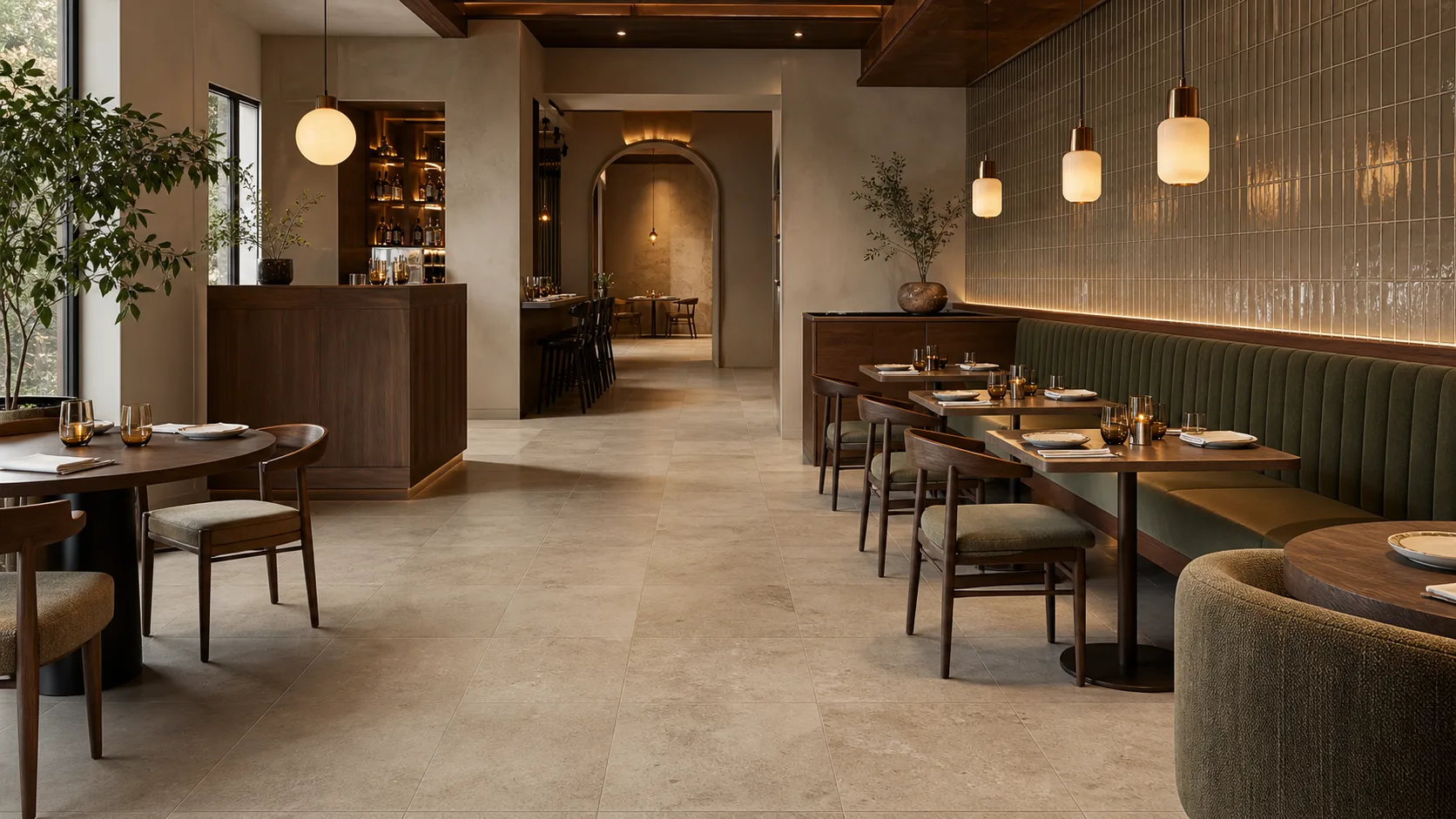
A successful restaurant interior must feel memorable to guests and manageable to the people who operate it. Porcelain tile can help create that balance when color, scale, traffic, lighting, cleaning, and acoustics are considered together.
Give the Space a Clear Visual Identity
Start with the feeling the restaurant should communicate: relaxed, energetic, refined, rustic, coastal, urban, or intimate. Tile can establish that identity through stone, concrete, wood, handmade, or decorative interpretations—without asking every surface to become a focal point.
Choose one visual leader. A patterned host wall, tiled bar front, or expressive restroom may carry the personality while the main floor remains calm enough to support furniture, food, signage, and people.
Use Tile to Connect and Distinguish Zones
| Area | Design opportunity | Practical question |
|---|---|---|
| Entrance and host | Create a strong first impression | Will wet shoes, queues, and door traffic affect the surface? |
| Dining room | Build a comfortable background | How will chair movement, crumbs, and frequent cleaning read? |
| Bar | Add color, texture, or detail | Can the selected surfaces handle spills and regular wiping? |
| Restrooms | Extend the brand with more freedom | Are floors, walls, joints, edges, and cleaning planned together? |
| Service areas | Prioritize clear, durable function | Does the complete assembly meet operational requirements? |
Balance Hard Surfaces with Light and Acoustics
Tile reflects light and sound. Glossy surfaces can animate a bar or feature wall, but reflections may become distracting under strong spotlights. Matte surfaces can feel quieter visually, yet color and texture still change under warm lamps, daylight, and low evening light.
Because restaurants already contain glass, dishes, conversation, and music, balance tile with upholstery, curtains, acoustic ceilings or panels, plants, and other sound-absorbing elements. A warm atmosphere comes from the full material composition—not from tile alone.
Make Performance Part of the Design
Traffic is not equal everywhere. Entrances, server routes, bar approaches, restroom paths, and chair zones may experience different wear, contaminants, and maintenance. Product suitability must be evaluated for each location rather than assumed from a tile’s appearance or a general “commercial” label.
- Confirm intended floor or wall use and written manufacturer recommendations.
- Evaluate surface characteristics in the actual area and likely conditions.
- Coordinate transitions, movement joints, exposed edges, and accessibility.
- Consider grout color, joint width, texture, and the cleaning program together.
- Keep replacement material from the same production run when practical.
For more performance-focused guidance, read Tile for High-Traffic Areas →
Approve the Real Combination
Review representative tile, grout, furniture, wood, metal, upholstery, and paint together under the intended lighting. A sample that looks calm in daylight may become highly reflective or change color under warm evening fixtures.
Before ordering, confirm the layout, cuts, transitions, exposed edges, quantities, maintenance expectations, substrate, setting system, and installation details with the project team. Restaurants are regulated environments; applicable building, accessibility, health, fire, and safety requirements must be addressed by qualified professionals.
Common Questions
Is porcelain tile a good choice for restaurants?
It can be. The exact product and installation must suit the location, traffic, contaminants, maintenance program, and applicable requirements.
Should the same tile be used everywhere?
No. A related palette can unify the space while different products or textures answer different zones.
Do dark floors hide dirt better?
Not always. They may hide some marks while highlighting dust, crumbs, streaks, or mineral residue.
Can polished tile be used?
Appearance alone cannot answer this. Confirm the product, location, contaminants, maintenance, traffic, and governing criteria.
How can tile feel less institutional?
Balance it with warm color, softer lighting, wood, upholstery, plants, textiles, and acoustic elements.
What should be approved before ordering?
Samples, lighting response, layout, grout, transitions, edges, cleaning, quantities, and written product suitability.