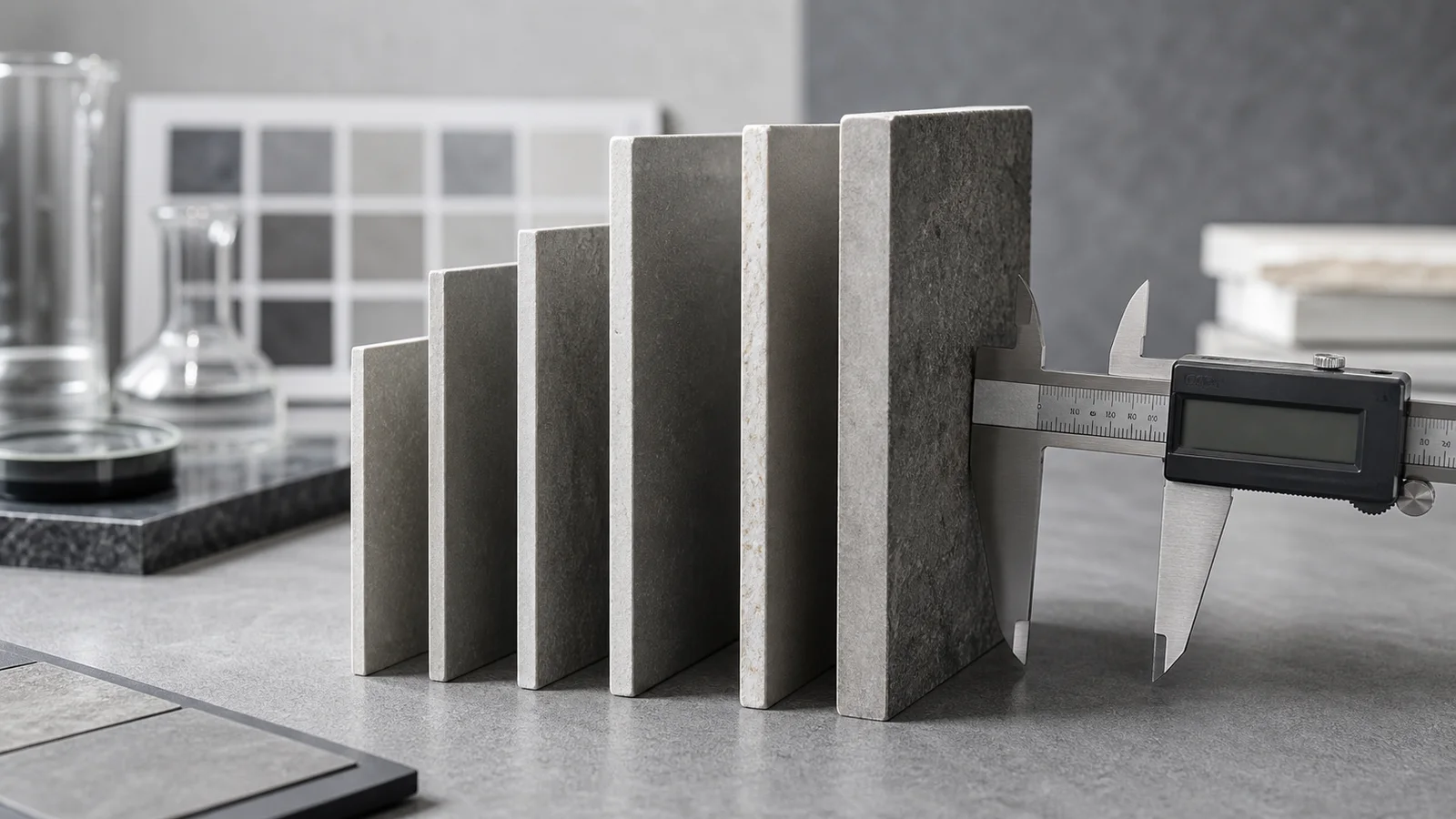
Porcelain tile thickness is the distance between the finished face and the back of the tile. It is an important dimensional characteristic, but it is not a stand-alone rating of quality, strength, or suitability.
What Tile Thickness Means
Thickness affects weight, edge transitions, setting-material needs, handling, cutting, and the way a tile integrates with adjacent finishes. It can also influence breaking force, but only as one part of a larger system that includes tile composition, format, manufacturing quality, support, installation, and expected loads.
Porcelain products now range from conventional tiles to thin panels and thicker exterior pavers. Those categories are not interchangeable. A thin panel may be engineered for a specific wall or floor assembly, while a thick paver may be intended for pedestal, gravel, grass, or bonded exterior systems. The manufacturer’s declared application remains essential.
How Porcelain Tile Thickness Is Measured
Thickness is measured on representative specimens at prescribed points. ASTM C499 covers facial dimensions and thickness for flat, rectangular ceramic wall and floor tile. ISO 13006 provides the broader international framework for definitions, classification, characteristics, and marking of ceramic tile.
Published dimensions may be described as nominal, work, manufacturing, or actual dimensions depending on the standard and market. A specification should identify the dimension being used and the allowed tolerance rather than relying on a rounded catalog number alone.
- Nominal thickness: the convenient product designation used in literature.
- Measured thickness: the result obtained from the physical specimen under the stated method.
- Tolerance: the permitted variation around the declared manufacturing dimension.
- Profile considerations: textured faces and back patterns can affect where and how the product is measured.
Thickness and Performance Are Related—But Not Equivalent
Two tiles with the same thickness can behave differently because of differences in body formulation, firing, porosity, internal defects, surface structure, and format. Conversely, products of different thicknesses can both be suitable when each is used in a correctly designed assembly.
Large panels deserve particular attention because increasing length changes handling and stress distribution. International guidance such as ISO/TR 17870-2 addresses the selection and installation of thin ceramic wall and floor tiles and panels, while ISO/TS 17870-3 addresses mechanically installed large-format porcelain tiles and panels. These documents reinforce that product geometry and installation method must be considered together.
For floors, the substrate, mortar coverage, movement accommodation, joints, concentrated loads, and workmanship affect the installed system. Product thickness cannot compensate for voids, excessive deflection, or an installation method outside the manufacturer’s instructions.
A Practical Selection Checklist
- Confirm whether the product is approved for wall, floor, exterior, façade, countertop, or pedestal use.
- Verify the declared thickness and applicable dimensional tolerance on the current technical sheet.
- Review breaking-strength or modulus-of-rupture data under the named test method.
- Check total assembly height, transitions, trim profiles, drainage, doors, and adjacent materials.
- Use the installation method, mortar, tools, and handling equipment required for that format.
- For unusual loads or assemblies, obtain project-specific direction from the manufacturer and qualified design professional.
Common Questions
What is the standard thickness of porcelain tile?
There is no single universal thickness for every porcelain tile. Thickness varies by format, manufacturing system, product family, and intended use. The current manufacturer data sheet is the correct source for a specific product.
Is thicker porcelain tile always stronger?
No. Thickness can affect breaking force, but body composition, geometry, firing, support conditions, and test method also matter. Compare declared performance under the same recognized test method.
Can thin porcelain tile be installed on a floor?
Only when the product is explicitly approved for that floor application and installed in the specified assembly. Thin tiles and panels require appropriate substrate preparation, handling, mortar coverage, and installation guidance.
Standards Referenced
This educational overview is grounded in the scope of the following current standards and guidance. Project specifications should use the complete, applicable editions and manufacturer instructions.
- ASTM C499-20 — facial dimensions and thickness of flat, rectangular ceramic wall and floor tile.
- ISO 13006:2018 — definitions, classification, characteristics, and marking for ceramic tile.
- ISO/TR 17870-2:2015 — installation guidance for thin ceramic wall and floor tiles and panels.
- ISO/TS 17870-3:2023 — mechanically installed large-format porcelain tiles and panels.