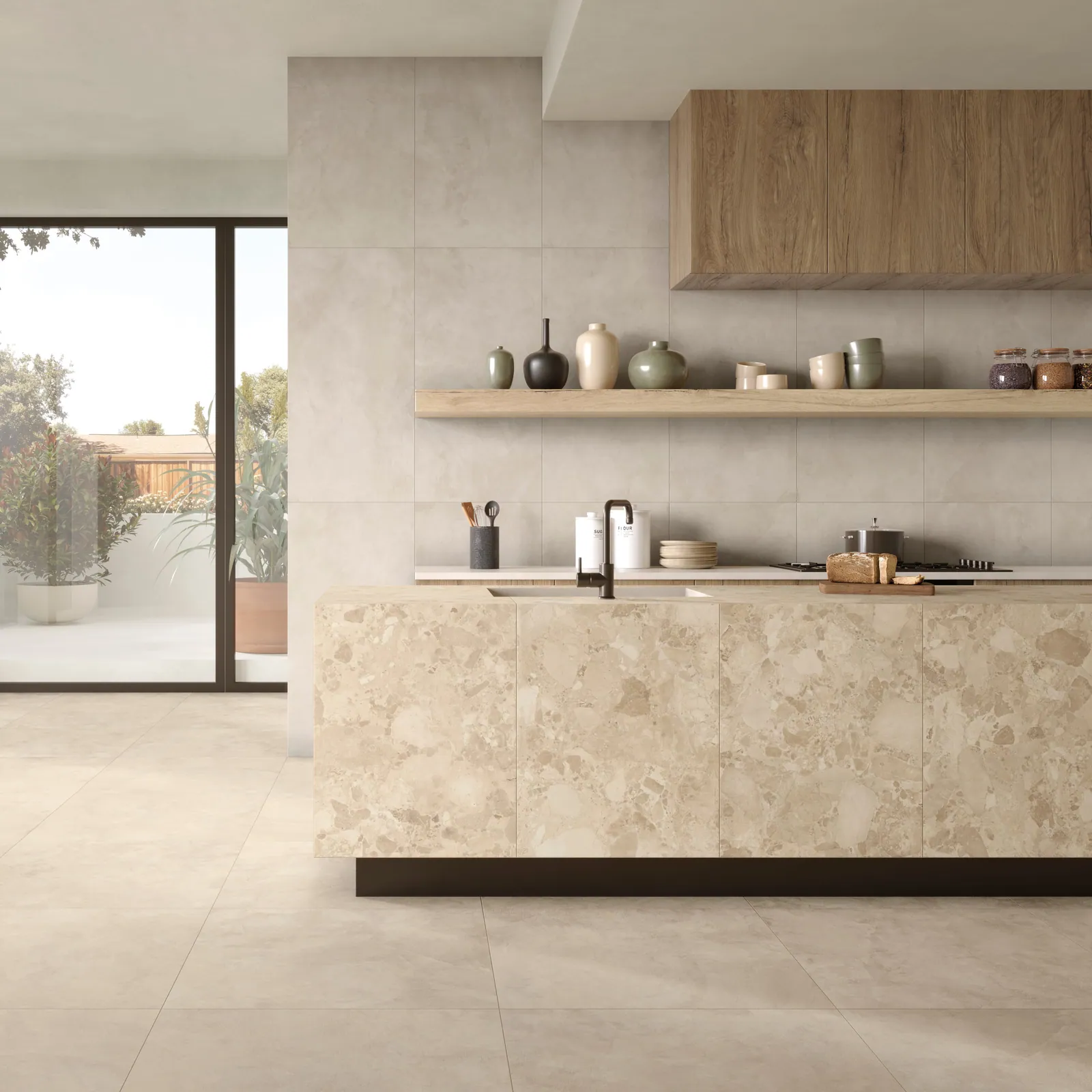
Large-format porcelain tile covers more surface with fewer pieces and fewer visible grout joints. Buyers often consider it when they want a visually continuous floor or wall, but the larger dimensions also make substrate preparation, handling, layout, mortar coverage, and installation skill especially important.
Definitions vary by market and document. In North American installation guidance, tile with at least one edge longer than 15 inches is commonly treated as large format; manufacturers and retailers may use the term differently. Today, manufacturers produce sizes such as 24 × 48 inches, 30 × 60 inches, 32 × 32 inches, 48 × 48 inches, and even porcelain slabs exceeding 63 × 126 inches, opening new possibilities for both residential and commercial projects.
Advances in manufacturing technology have made these larger formats stronger, flatter, and more dimensionally precise than ever before. As a result, large format porcelain is now commonly installed on floors, walls, showers, fireplaces, countertops, exterior façades, and even custom furniture.
What Size Is Considered Large Format?
The term "large format" does not describe a specific tile size but rather a category of porcelain tiles significantly larger than traditional formats.
While definitions vary slightly among manufacturers and industry organizations, tiles measuring 24 × 24 inches (600 × 600 mm) or larger are generally recognized as large format. Over the last decade, the industry has steadily shifted toward even larger dimensions, with 24 × 48 inches becoming one of the most popular sizes for modern residential projects.
Very large porcelain panels and slabs can also be used for walls, countertops, shower surrounds, and architectural features. These products form a specialized category with distinct handling and installation requirements.
Why Are Large Format Porcelain Tiles So Popular?
One of the greatest advantages of large format porcelain is its ability to simplify a space visually. Because fewer individual tiles are required to cover the same surface, grout joints become less noticeable, allowing the beauty of the porcelain itself to take center stage.
The result is an environment that appears larger, cleaner, and more refined. This visual continuity has made large format porcelain one of the preferred materials for contemporary homes, luxury hotels, commercial buildings, and high-end retail spaces.
Another important advantage is design flexibility. The same porcelain collection can often be used throughout an entire project—from interior floors and bathrooms to outdoor patios—creating a seamless transition between spaces.
Advantages of Large Format Porcelain Tile
Large-format porcelain can combine broad visual continuity with the documented performance of the selected product.
Installation Considerations
Large format porcelain rewards precision. Because each tile covers a much larger surface area, the quality of the substrate becomes considerably more important than with smaller tiles.
Even slight irregularities in the floor can produce lippage, where adjacent tile edges are not perfectly aligned. For this reason, professional installers often use tile leveling systems and carefully prepare the substrate before installation begins.
Many large-format porcelain products have rectified edges, meaning the fired tile edges are mechanically finished for more precise facial dimensions. Rectified does not mean identical or jointless: actual caliber, edge profile, warpage, and tile-size variation still determine an appropriate grout joint. See our technical reference on grout joints and rectified porcelain tile.
Mortar selection, trowel choice, back-buttering, coverage, movement accommodation, and expansion provisions become increasingly important as tile dimensions increase. Service life depends on the product, substrate, installation system, environment, use, and maintenance.
Where Is Large Format Porcelain Commonly Used?
Large format porcelain is one of the most versatile surfacing materials available today.
Maintenance
One of porcelain's greatest advantages is its ease of maintenance. Routine cleaning generally requires only warm water and a pH-neutral cleaner. Unlike many natural stones, porcelain does not require periodic sealing, making it an excellent long-term solution for busy households and commercial environments.
Simple, consistent maintenance is usually all that is necessary to preserve its appearance for many years.
What to Remember
Large-format porcelain can create broad, visually continuous surfaces, but size alone does not determine suitability or quality.
Before buying, confirm the exact dimensions, finish, variation, intended application, installation requirements, movement-joint provisions, and maintenance guidance for the selected product.
Common Questions
Is 24 × 24 inches considered large format?
It is commonly treated as large format, although terminology varies. Installation requirements should be based on the exact product dimensions and applicable standards, not the marketing label alone.
Does a larger tile make a room look bigger?
It can create greater visual continuity because there are fewer grout joints, but color, layout, lighting, furniture, and the room’s proportions also affect the result.
Can large-format tile be installed over an uneven floor?
The substrate normally requires careful evaluation and preparation. Large units do not bend around irregularities, so flatness is especially important.
Does rectified mean the tile can be installed without grout?
No. Rectification improves dimensional precision; it does not eliminate grout joints, movement accommodation, or installation tolerances.