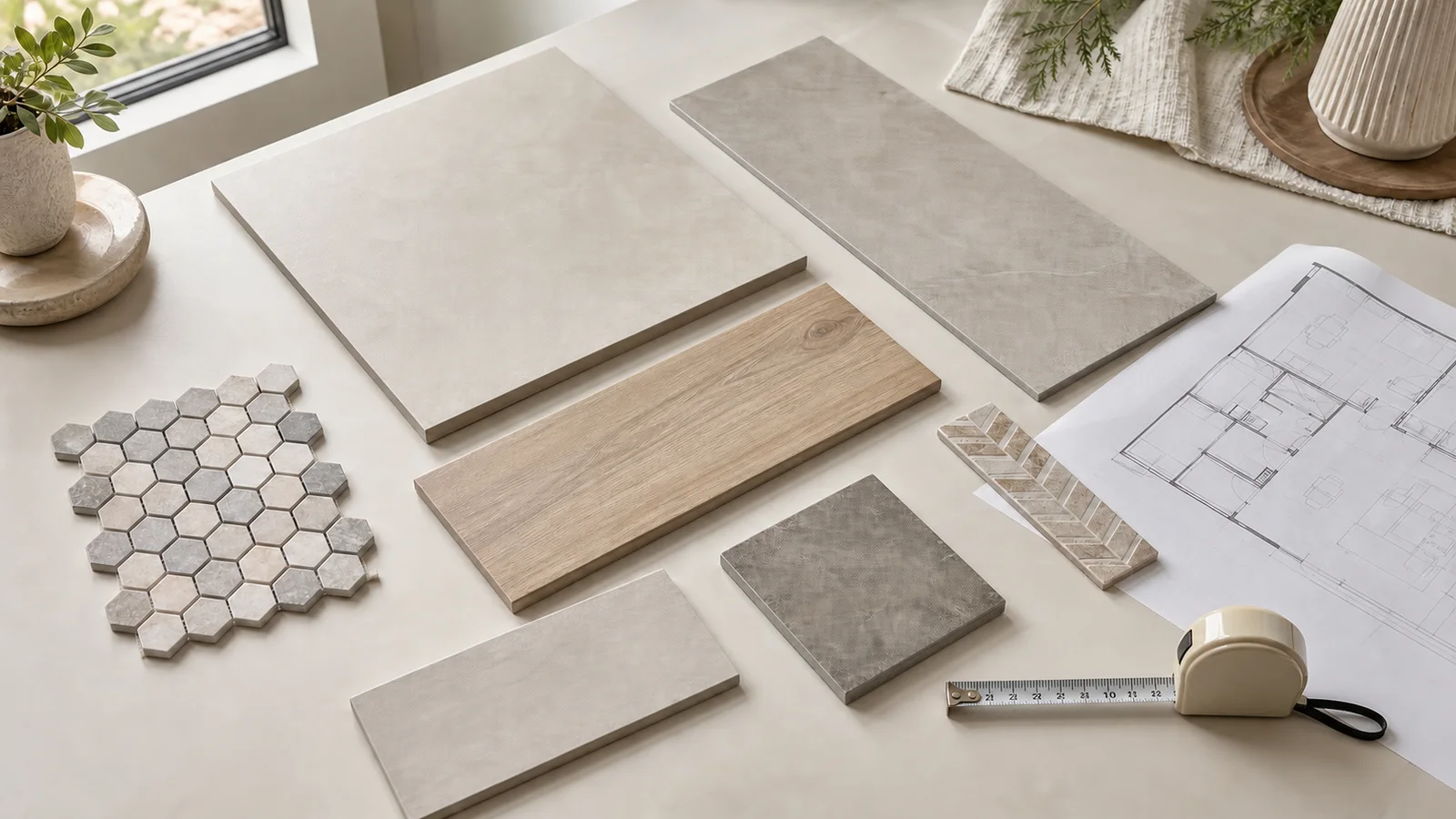
Start with where the tile will go—not simply whether the room is big or small. The best size is one that suits the surface, looks balanced after cutting, and fits your installation budget.
Start With the Surface, Not the Room Size
One room may need several sizes. A bathroom can use a large floor tile, a coordinating wall tile, and a small mosaic that follows the shower slope.
- Choose the surface: main floor, shower floor, wall, backsplash, or outdoor area.
- Confirm the tile is approved there. Wall, floor, shower, and exterior uses are not interchangeable.
- Measure around real obstacles: doors, drains, niches, cabinets, and transitions.
- Sketch the tile grid. A good size produces balanced cuts instead of thin strips at the edges.
What Do the Main Tile Formats Do Best?
| Format | Common strengths | Watch for |
|---|---|---|
| Mosaics and very small tile | Can follow shower slopes and curved surfaces; adds texture, pattern, and detail | More grout to clean; sheet alignment; exact wet-floor approval; higher installation detail |
| Small rectangles and squares | Flexible around backsplashes, niches, and small walls | More joints to grout and clean |
| Medium square or rectangle | Versatile for many home floors and walls; easier handling | Strong grout contrast can make the layout look busy |
| Large-format square or rectangle | Fewer joints and a calm, continuous appearance; showcases stone and concrete graphics | Flatter substrate, heavier handling, specialty cutting, mortar coverage, lippage, and balanced cuts |
| Plank tile | Creates directional flow and supports wood-look designs | Warpage and offset limitations; narrow corridors; alignment across connected rooms |
Do Small Rooms Need Small Tile?
No. Large tile can look calm and expansive in a small room because fewer grout lines interrupt the surface. Small tile can make the same room feel detailed, rhythmic, traditional, or deliberately decorative. Neither effect is automatically right.
What matters is how the tile fits. If one full tile leaves thin strips on both sides, another size may look better. Try full-size samples or paper templates on the floor.
Room-by-Room Starting Points
| Area | Friendly starting point |
|---|---|
| Main floors | Medium or large tile can create a calm flow. Check cuts through doors and around islands. |
| Small bathroom | Large or small tile can work. Choose the layout with the better-looking edge cuts. |
| Shower floor | Mosaics commonly follow the drain slope more easily. Confirm the exact tile is approved for this use. |
| Shower walls | Large tile gives fewer joints; smaller tile fits niches and fixtures more easily. |
| Backsplash | Small formats add detail; larger pieces create a quieter background. |
Two Details Buyers Often Miss
Actual size: a tile called 24 × 48 inches may measure differently. Use the real dimensions plus the grout joint when planning cuts.
Installed cost: larger tile does not always cost less. It may need a flatter floor, special cutting tools, and extra handling. Ask for a quote using the exact tile and pattern.
The Showroom Checklist
- Bring measurements and photos.
- Confirm the tile is approved for the intended surface.
- Ask for the actual tile dimensions and recommended grout joint.
- Take home a full-size sample or make a paper template.
- Ask where the cut pieces will appear.
- Get an installation quote for the exact size and pattern.
- Let the installer calculate waste and extra material from the layout.
Common Questions
What tile size makes a small room look bigger?
There is no guaranteed size. Larger tile with a calm pattern and coordinated grout can reduce visual interruption, but the layout should avoid awkward slivers and excess waste. Test the actual room using actual tile dimensions.
Can large-format tile be used in a small bathroom?
Yes. It can work well when the layout produces balanced cuts and the substrate, drainage, handling, and installation conditions are suitable.
Why are mosaics commonly used on shower floors?
Small pieces can follow the slope toward a drain more easily, and their many grout joints may contribute texture. The exact mosaic must still be approved for shower floors and evaluated for wet slip behavior.
Is larger porcelain tile cheaper to install?
Not automatically. Fewer pieces and grout joints may be offset by substrate preparation, handling, specialty cutting, mortar coverage, additional labor, and breakage risk.
What is the difference between nominal and actual tile size?
Nominal size is the trade name for the format. Actual size is the real measured facial dimension used to plan layouts, joints, niches, transitions, and cuts.
How much extra tile should I buy?
The allowance depends on room geometry, pattern, format, breakage risk, lot availability, and future repairs. Ask the installer to calculate it from the approved layout rather than applying one percentage to every project.