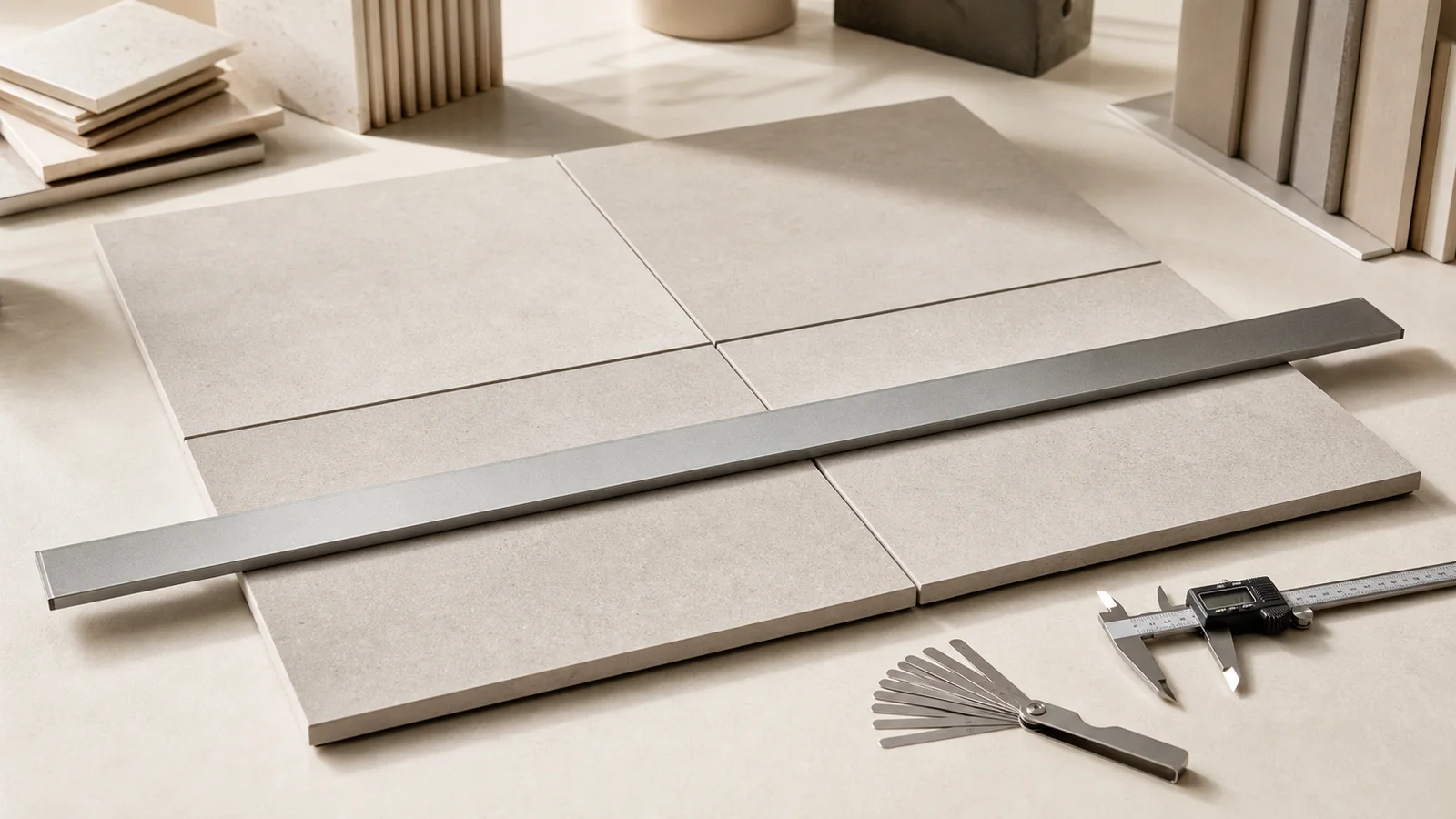
Dimensional consistency describes how closely porcelain tiles conform to specified size, thickness, edge, squareness, and flatness requirements. Dimensional stability describes resistance to dimensional change or the controlled movement of the tile and installation over time. The terms are related, but they do not mean that every tile is perfectly identical or that an installed surface will never move.
Why Do Dimensions Vary?
Porcelain tile is formed from ceramic raw materials and fired at high temperature. Drying and firing produce shrinkage, and manufacturers control this process through formulation, pressing, kiln management, sorting, calibration, and—in some products—rectification.
Controlled variation is normal in ceramic manufacturing. Product standards define how dimensional characteristics are tested and which tolerances apply to a declared tile category. The important question is not “Are all pieces mathematically identical?” but “Does the supplied product conform to its applicable specification and work with the intended joint, pattern, and installation?”
Which Dimensional Characteristics Are Measured?
ISO 10545-2:2018 specifies methods for determining length, width, thickness, straightness of sides, rectangularity, surface flatness, and surface quality. In North American specifications, ASTM methods commonly referenced for dimensional analysis include ASTM C499 for facial dimensions and thickness, ASTM C485 for warpage, and ASTM C502 for wedging.
| Characteristic | What it describes | Why it matters |
|---|---|---|
| Length and width | The actual facial dimensions of each tile | Affects joint uniformity, layout, module, and compatibility between cartons |
| Thickness | The body thickness measured at defined locations | Affects transitions, profiles, setting-bed planning, and compatibility with adjacent materials |
| Straightness of sides | Deviation of an edge from a straight line | Influences how consistently neighboring edges align |
| Rectangularity or wedging | How closely corners and opposing sides form the intended geometry | Influences square layouts, joint continuity, and cumulative alignment |
| Surface flatness or warpage | Curvature measured along edges, diagonals, or the tile center | Affects contact, lippage risk, pattern selection, and the visual plane |
| Surface quality | Visible conformity of the face under the applicable method | Separates dimensional evaluation from intended texture and acceptable appearance |
A passing result in one category does not prove performance in every other category. A tile can have consistent length and width while still having measurable warpage, or it can be flat while showing more edge-size variation.
Warpage Is Not the Same as Lippage
Warpage is curvature within an individual tile. ASTM C485 measures corner, diagonal, and edge warpage for applicable ceramic tile categories. ISO 10545-2 includes surface-flatness measurements.
Lippage is a difference in elevation between the edges of adjacent installed tiles. It is an installation outcome influenced by tile warpage, substrate flatness, mortar thickness, joint width, layout pattern, tile format, and workmanship.
Long rectangular tile deserves particular attention. When the high point near the center of one tile is placed beside the lower end of another in an offset pattern, otherwise small curvature can become visually and physically more apparent.
Nominal Size, Actual Size, and Caliber
Nominal size is the trade designation used to identify a format. Actual size is the measured facial dimension. A product sold as 24 × 48 inches may not measure exactly 24 × 48 inches, and actual dimensions can differ between manufacturers or collections.
Caliber is a dimensional grouping used to identify tiles with compatible actual dimensions. Carton labels may carry a caliber, size code, work size, or similar production identifier. The terminology varies, but its project purpose is consistent: keep compatible pieces together so joint alignment can be controlled.
- Confirm that all cartons belong to compatible caliber and production information.
- Do not assume two colors or finishes in the same collection have identical actual dimensions.
- Do not mix replacement cartons into an existing installation without checking size and shade compatibility.
- Dry-lay representative pieces from multiple cartons before setting begins.
Does Rectification Guarantee Dimensional Consistency?
Rectification mechanically finishes the fired edges to achieve more precise facial dimensions. It normally improves straightness and size control at the perimeter, which can support a narrower, more uniform joint appearance.
Rectification does not guarantee zero dimensional variation, identical thickness, perfect surface flatness, zero warpage, or a lippage-free installation. The exact product data and recommended grout joint still control.
For a focused explanation, read Is This Porcelain Tile Rectified? →
Does Porcelain Tile Move After Installation?
Yes. A tile assembly contains multiple materials—tile, grout, mortar, membranes, substrates, structural components, and perimeter conditions—that respond differently to temperature, moisture, loading, and building movement.
ASTM C372 addresses linear thermal expansion of porcelain enamel and ceramic materials, while ASTM C370 addresses moisture expansion of fired whiteware products. These properties are different from manufacturing size consistency. Even a highly consistent porcelain tile installation requires correctly designed movement accommodation.
Grout joints and movement joints also serve different purposes. Grout fills regular joints between tiles; designated movement joints remain compressible and accommodate movement at required locations. Tile should not be installed tightly against walls, columns, transitions, or other restraining surfaces contrary to the applicable design and installation requirements.
What Should Be Verified Before Installation?
- Identify the applicable standard: obtain the manufacturer’s declared product specification and current technical sheet.
- Compare nominal and actual dimensions: plan the module, layout, transitions, cuts, and joint width using real product information.
- Check every carton: confirm SKU, size, thickness, caliber, shade, finish, production lot, and quantity before opening the installation.
- Sample multiple boxes: inspect and dry-lay pieces to reveal dimensional, color, pattern, and surface variation.
- Measure the substrate: verify flatness and suitability before tile-setting begins, especially for large formats and narrow joints.
- Review the pattern: confirm any manufacturer limitations for offsets, staggered layouts, and large rectangular tile.
- Use an appropriate grout joint: allow for the actual dimensional variation and follow the product and installation requirements.
- Plan movement accommodation: coordinate perimeter, field, structural, and environmental movement conditions.
- Keep attic stock: retain clearly labeled material from the same production lot for future repairs.
Common Questions
Are all porcelain tiles the exact same size?
No. Ceramic manufacturing standards permit controlled tolerances. Evaluate tile against the applicable standard and compatible caliber rather than expecting absolute identity.
What is tile caliber?
Caliber is a dimensional grouping used to identify tiles with compatible actual facial dimensions. Cartons for one installation should normally carry compatible caliber information.
Is tile warpage the same as lippage?
No. Warpage is curvature within one tile. Lippage is an elevation difference between adjacent installed edges and can result from tile, substrate, layout, mortar, joint, and workmanship factors.
Does rectified tile guarantee perfect dimensions and flatness?
No. Rectification improves edge and facial-dimension precision. It does not guarantee zero size variation, identical thickness, perfect flatness, or a lippage-free installation.
Does porcelain tile expand and contract?
Yes. Porcelain tile and the surrounding assembly respond to temperature and other conditions. Movement accommodation remains necessary even when the tile is dimensionally consistent.
Can tiles from different production lots be mixed?
Only after verifying compatible dimensions, caliber, shade, finish, and manufacturer guidance. Unverified lots can create visible size, joint, color, or surface differences.