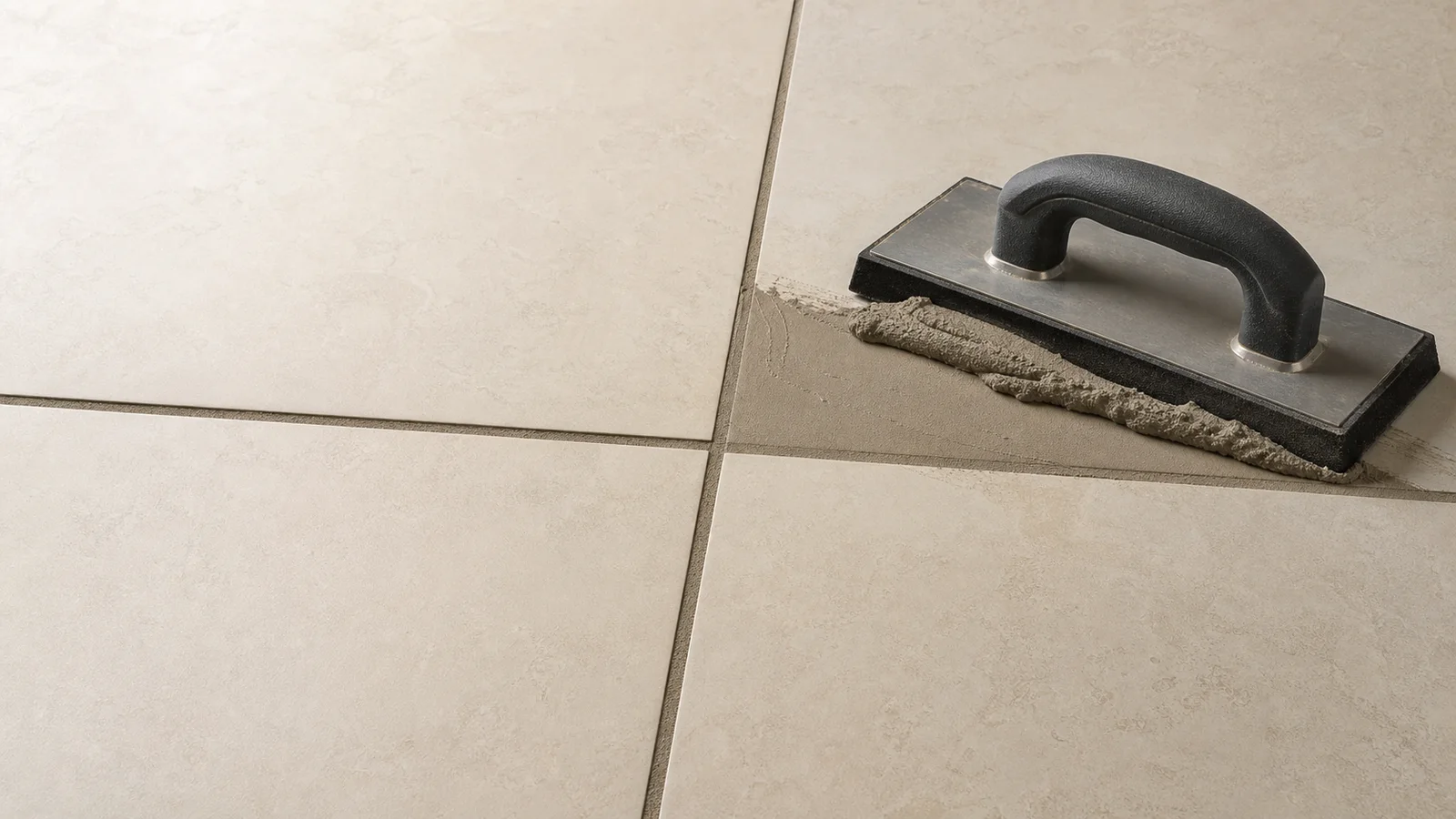
A grout joint is the intentional space between adjacent tiles that is filled with a compatible grout material. Its width helps the installation accommodate tile-size variation, maintain a coherent layout, and produce a serviceable finished surface.
Why Grout Joints Matter
Porcelain tile is manufactured to controlled tolerances, but tiles are not mathematically identical. Facial dimensions, edge profile, thickness, warpage, and the plane of the substrate can vary. A properly selected joint gives the installer room to distribute those differences rather than concentrating them into visibly uneven lines.
Grout joints also contribute to the visual scale of the installation. Their width, color, depth, and consistency influence whether the surface reads as a continuous field, a geometric grid, or a deliberately contrasted pattern.
How Grout-Joint Width Is Selected
ANSI A108.02 contains workmanship requirements for tile installation, while TCNA guidance explains that joint selection depends on actual tile variation and project conditions. The supplied tile should be measured—not judged only by the nominal size printed on the box.
A widely cited ANSI principle is that the actual grout-joint size should be at least three times the actual variation in facial dimensions of the tile supplied. This relationship makes the joint responsive to the material in the project rather than an assumed catalog dimension. Manufacturer instructions or a project specification may establish additional minimums.
- Tile-size variation: greater difference between the largest and smallest pieces requires more adjustment space.
- Edge profile: irregular, pillowed, beveled, or rustic edges visually change the finished joint.
- Tile format: long and large-format tiles can make warpage, alignment, and lippage more noticeable.
- Substrate plane: humps and depressions can make a joint appear wider or narrower as the tile follows the surface.
- Pattern: running bonds, modular layouts, and mixed formats require coordinated dimensions and joint lines.
- Grout product: every grout has an approved joint-width range and application instructions.
Where Is a Grout Joint Measured?
Joint spacing is measured between the tile edges, not across the flared opening created by a bevel. Grout should be installed and tooled according to the tile and grout manufacturer’s instructions rather than used to cover a decorative edge profile.
Because a bevel can make the visible surface opening look wider than the actual spacing below, two installations with the same tile-edge spacing may appear different. Samples or mockups are useful when joint appearance is critical.
Rectified Porcelain Tile Still Requires Grout Joints
Rectified tile has mechanically finished edges intended to provide more precise facial dimensions. That precision can support a narrower and more controlled appearance when the product variation, substrate, layout, and grout allow it.
Rectification does not eliminate dimensional tolerance, warpage, installation tolerance, or movement. A zero-width or butt-jointed porcelain installation leaves no practical space for grout and can make small size differences, edge chips, alignment changes, and lippage more visible.
Before selecting a narrow joint, dry-lay and measure pieces from multiple cartons. Review the tile manufacturer’s declared calibration or sizing, the applicable product standard, and the installer’s assessment of the actual material.
Large-Format Tile, Warpage, and Layout
Long rectangular tiles can have slight curvature within allowed manufacturing tolerances. When the high point of one tile is placed beside the low point of another, lippage becomes more noticeable—particularly in running-bond patterns and under grazing light.
Joint width cannot correct an unsuitable substrate or eliminate warpage, but a realistic joint can help distribute dimensional variation and reduce visual emphasis. Layout, offset, substrate flatness, mortar coverage, leveling practices, and lighting must be coordinated before installation begins.
Choosing a Grout Material
The grout material must be compatible with the joint width, tile surface, exposure, maintenance program, and installation location. The current ANSI A108/A118/A136.1 compilation includes specifications for cementitious, epoxy, and premixed grout categories.
| Grout category | Relevant standard | Selection considerations |
|---|---|---|
| Standard cementitious grout | ANSI A118.6 | Joint range, water control, curing, color consistency, sealing guidance |
| High-performance cementitious grout | ANSI A118.7 | Enhanced performance criteria, approved uses, installation instructions |
| Epoxy grout | ANSI A118.3 | Chemical and stain demands, working characteristics, surface compatibility |
| Organic premixed grout | ANSI A118.19 | Approved locations, cure conditions, joint range, manufacturer limitations |
Terms such as sanded and unsanded remain common, but modern formulations vary. Do not select grout solely by a traditional rule of thumb. Use the grout manufacturer’s current joint-width range and test the product on polished, delicate, textured, or scratch-sensitive surfaces before full installation.
Grout Color and Finished Appearance
A close color match reduces the visual prominence of the grid; a contrasting color emphasizes tile geometry. Real grout can appear different from a printed chart because water, mixing, cleaning, curing, lighting, sealers, surrounding materials, and joint depth affect the result.
Use a physical sample or project mockup when color is important. The same grout color can also look different beside warm, cool, light, or dark tiles.
Grout Joints Are Not Movement Joints
A grout-filled joint is rigid and is not a substitute for a designed movement joint. Tile assemblies expand, contract, deflect, and respond to moisture and temperature. TCNA Handbook Detail EJ171 provides movement-joint guidance, and TCNA emphasizes that tile installations require accommodation for movement.
Movement joints use a compressible joint system or appropriate sealant rather than ordinary grout. They are typically required at changes in plane, perimeters, transitions, existing structural or movement locations, and within fields of tile as determined by the project conditions and design.
Filling a location intended for movement with rigid grout can lead to cracked grout, damaged tile, debonding, or tenting. Exact placement and frequency must be determined from the current standard, TCNA guidance, manufacturer requirements, and project-specific exposure.
Grout Joints Are Not Waterproofing
Grout completes and protects the visible joint, but grout joints should not be treated as the waterproofing system. Showers and other wet areas require a properly designed substrate, membrane or approved installation method, drainage, penetrations, and movement accommodation behind or beneath the tile finish.
Before Approving a Grout Joint
- Measure tile from several cartons and record actual facial-dimension variation.
- Confirm whether the product is rectified, calibrated, natural-edge, beveled, or intentionally irregular.
- Review substrate flatness, tile warpage, format, layout, offset, and lighting.
- Verify the tile and grout manufacturers’ permitted joint widths and surface compatibility.
- Create a dry layout or mockup showing the proposed joint and grout color.
- Separate rigid grout joints from required movement joints and changes of plane.
- Confirm waterproofing independently in showers and other wet assemblies.
Common Questions
What is the minimum grout joint for rectified porcelain tile?
There is no universal minimum for every rectified tile. The joint must account for actual tile-size variation, edge profile, warpage, substrate, layout, grout product, manufacturer instructions, and project requirements.
Can porcelain tile be installed without grout joints?
Butt-joint installation is generally inappropriate. Even rectified tile retains tolerances, and the installation needs space for grout and realistic alignment. Follow the tile manufacturer and applicable installation standard.
Should grout-joint width be measured at the bevel?
No. Spacing is measured between tile edges, not across the wider visual opening created by a bevel. The finished appearance should be confirmed with a sample or mockup.
Does a wider grout joint prevent tile cracking?
Not by itself. Grout-joint width and movement accommodation are different issues. Cracking can involve substrate movement, deflection, coverage, curing, missing movement joints, or other installation conditions.
Are grout joints waterproof?
No. Grout is not a substitute for a waterproofing system. Wet areas require an approved assembly behind or beneath the tile and grout surface.
Standards and Sources Referenced
This educational overview uses the public scopes and guidance below. Installation decisions should follow the complete current standards, TCNA Handbook, manufacturer instructions, and project documents.
- ANSI A108/A118/A136.1:2024 — installation workmanship and material specifications for ceramic tile systems.
- TCNA Grout FAQ — joint-width variables, tile variation, bevel measurement, grout selection, and changes of plane.
- ISO 10545-2:2018 — dimensional characteristics and surface quality of ceramic tile.
- TCNA Movement-Joint Placement FAQ — movement accommodation and reference to Handbook Detail EJ171.
- TCNA Cracked/Loose Grout FAQ — common causes including deflection, incomplete joint filling, and excess water.
- TCNA Ceramic Tile FAQ — installation guidance and the distinction between grout and wet-area waterproofing.