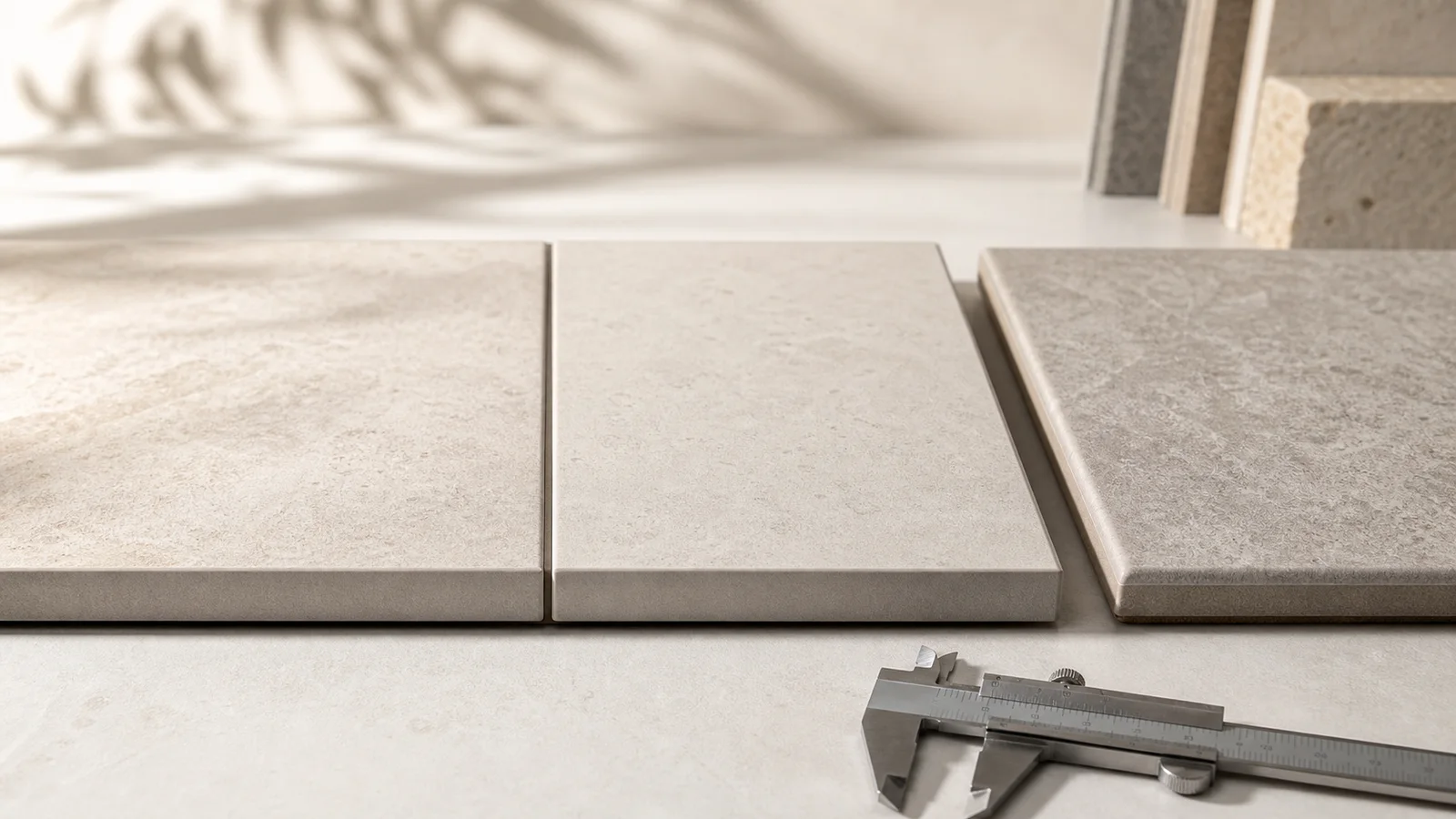
Rectified porcelain tile is tile whose edges are mechanically finished after firing to create more precise facial dimensions. The answer to “Is that rectified?” matters because edge precision affects the visual character of the grout grid and the tolerances available during installation—but it does not mean the tile can be installed without grout.
What Does “Rectified” Mean?
Porcelain tile changes dimension slightly during firing. In a rectified product, the fired tile passes through an additional machining process that finishes its perimeter to tighter facial dimensions. This normally produces straight, consistent edges and square corners.
Rectification describes an edge and dimensional-finishing process. It does not describe the tile’s water absorption, body composition, surface finish, slip resistance, abrasion resistance, strength, shade variation, or suitability for a particular space.
The Tile Council of North America explains that rectified tile helps address dimensional variation when narrow joints are desired, but substrate flatness, mortar consistency, installer proficiency, tile warpage, and layout pattern remain separate considerations.
How Can You Tell If Porcelain Tile Is Rectified?
The reliable answer comes from the product documentation—not from appearance alone. Check, in this order:
- Technical data sheet: look for “rectified,” “rectified edge,” or a manufacturer-specific rectified-edge designation.
- Carton and sample label: confirm that the label belongs to the exact collection, nominal size, color, finish, and caliber being purchased.
- Manufacturer grout recommendation: a declared joint width helps explain how the product is intended to be installed, but a narrow recommendation alone is not proof of rectification.
- Physical sample: a straight, crisp, consistent perimeter can support the documentation, but some pressed products look precise and some rectified products retain a slight top-edge bevel.
Do not rely only on a salesperson’s description or a website category filter. Request the current technical sheet for the exact SKU.
Rectified vs. Non-Rectified, Pressed, and Calibrated Tile
| Term | What it generally means | What the buyer should expect |
|---|---|---|
| Rectified | Edges mechanically finished after firing for more precise facial dimensions | Straighter edges and the possibility of a controlled narrow-joint appearance, subject to the product and installation requirements |
| Pressed or non-rectified | Edges retain the form produced by pressing and firing rather than being mechanically squared afterward | A softer, beveled, pillowed, rustic, or slightly more variable edge may require a visually wider joint |
| Calibrated | Tile sorted into dimensional groups or calibers after firing | Pieces within a caliber are grouped for size compatibility, but calibration is not the same machining process as rectification |
| Natural or irregular edge | Edge intentionally preserves a handcrafted, cleft, or rustic profile | Joint width will appear more variable and is part of the intended design |
Terminology can vary between standards, markets, and manufacturers. The declared tolerances and installation recommendation for the actual product are more useful than an assumed meaning based only on the label.
Does Rectified Tile Need a Grout Joint?
Yes. Rectified tile is not groutless tile. Narrow joints leave less room to absorb variation in tile dimensions, substrate plane, layout, mortar thickness, and workmanship. They can also make lippage and alignment differences more visible.
TCNA guidance notes that joint selection should account for variation between tiles, edge shape, tile size, surface, application, and substrate conditions. The joint is measured between the tile edges—not from the top of a bevel—and the manufacturer’s recommendation for the exact product should be followed.
A rectified edge addresses dimensional precision; it does not eliminate:
- actual size or caliber variation between production lots;
- allowable tile warpage;
- substrate flatness requirements;
- lippage considerations;
- movement and expansion joints;
- the need for grout and correct mortar coverage.
For joint-width planning, continue with What Do Grout Joints Mean in Porcelain Tile Installation? →
Is Rectified Tile Better?
Rectified tile is better when its precise-edged appearance supports the design and the installation conditions can support it. It is not universally better.
| Rectified may be preferred when | Pressed or expressive edges may be preferred when |
|---|---|
| The design calls for a clean, continuous, tightly controlled grid | The design calls for a traditional, handcrafted, rustic, or softened appearance |
| Large formats need visually consistent alignment | The edge profile is intentionally part of the tile’s character |
| The substrate can be prepared to the required flatness | A wider joint better accommodates dimensional and surface variation |
| A skilled installer is available for the selected pattern and joint | Installation tolerances or project conditions do not favor a very narrow joint |
What to Ask Before Buying Rectified Porcelain Tile
- Is the exact SKU declared rectified? Verify the size, finish, and color—not only the collection name.
- What is the recommended grout-joint width? Obtain the manufacturer’s written recommendation for the intended pattern.
- What are the nominal and actual dimensions? A “24 × 48” tile may have different documented actual dimensions.
- Are all cartons the same caliber and shade lot? Confirm labels before installation and avoid mixing incompatible lots.
- What pattern is permitted? Long rectangular tiles may have offset limitations because warpage becomes more visible in staggered layouts.
- What substrate flatness is required? Narrow-joint, large-format work depends heavily on preparation.
- Are finished edge pieces available? Rectified does not mean the exposed body edge is decorative; walls may still need bullnose, trim, profiles, miters, or factory-finished edges.
- Has the installer priced the intended detail? Precision layouts and substrate correction can require more labor than a standard installation.
Common Questions
What does rectified porcelain tile mean?
Its edges are mechanically finished after firing to achieve more precise facial dimensions and straighter, more consistent edges.
Does rectified tile mean no grout line?
No. Rectified tile still requires grout joints. The appropriate width depends on actual dimensional variation, edge profile, warpage, pattern, substrate, installation requirements, and manufacturer guidance.
How can I tell whether a tile is rectified?
Check the manufacturer technical sheet, carton, or declared edge specification for the exact SKU. Visual inspection can support—but should not replace—the documentation.
Is rectified porcelain tile better?
It is more precise at the edges and can support a controlled narrow-joint aesthetic. It is not automatically more durable, slip resistant, stain resistant, or suitable for every use.
Is rectified tile harder to install?
A narrow-joint rectified installation generally demands a flatter substrate, careful layout, consistent mortar coverage, lippage control, and proficient workmanship.
Are rectified and calibrated tile the same?
No. Calibration sorts tiles into dimensional groups; rectification mechanically finishes their edges. Confirm how the current manufacturer uses each term.