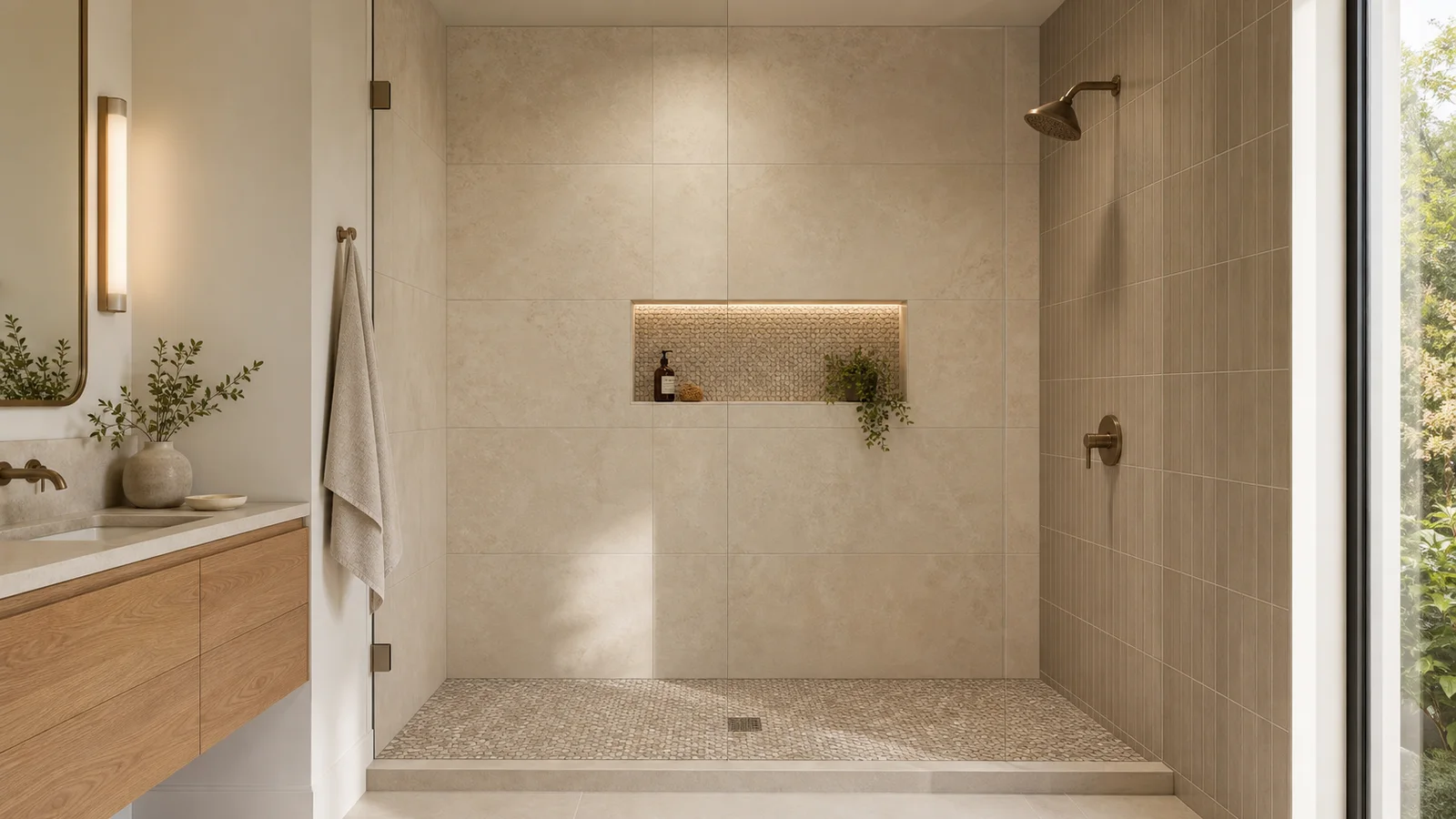
The best shower walls feel designed as one composition—not as three surfaces covered independently. Tile scale, grout lines, fixtures, niche placement, glass, lighting, and ceiling height should relate to one another before installation begins.
Choose One Main Idea
A shower can be quiet and continuous, graphic and modular, warm and textured, or dramatic and slab-like. It rarely needs every idea at once.
| Approach | Visual effect | Planning priority |
|---|---|---|
| One tile throughout | Calm, cohesive, visually larger | Balanced cuts and consistent joint alignment |
| Feature plumbing wall | Draws attention to the main shower wall | Fixture, grout, and pattern symmetry |
| Contrasting niche | Adds one controlled focal point | Clean edges, slope, alignment, and scale |
| Large panels or slabs | Broad movement and fewer visible joints | Handling, substrate, seams, corners, and penetrations |
| Small-format field | More rhythm, texture, and color opportunity | Joint consistency and maintenance expectations |
Use Tile Scale to Control Visual Energy
Large-format tile creates broad fields and lets stone-, marble-, or concrete-inspired graphics read across the wall. Medium rectangles provide an architectural grid. Narrow vertical formats make the wall feel taller, while horizontal layouts can emphasize width.
Small tile adds texture and movement but also introduces more joints. Use it deliberately—throughout the shower, on one wall, or inside a niche—rather than as an automatic accent stripe.
A Feature Wall Should Have a Reason
The plumbing wall is a natural focal point because the eye already reads the showerhead and controls as a composition. A wall behind a freestanding bench, a long niche, or a window can also become the visual anchor.
Contrast can come from color, format, texture, direction, or sheen. Changing all five at once often makes the shower feel fragmented. One or two controlled differences are usually enough.
Make Niches, Corners, and Edges Intentional
- Align the niche with the tile grid when practical.
- Decide whether niche backs match, contrast, or continue the main pattern.
- Plan finished edges with coordinating trim, profiles, bullnose, miters, or another approved detail.
- Review inside corners, glass edges, curbs, benches, windows, and ceiling transitions together.
- Allow the installer to adjust dimensions for waterproofing, slope, tile thickness, and clean cuts.
Grout and Lighting Complete the Design
A closely related grout color softens the grid. Contrast makes every tile and joint more visible. Neither choice is universally better, but the grout should be tested beside the actual tile—especially with textured, porous-looking, polished, or light-colored surfaces.
Light grazing across a textured wall can create beautiful shadow, but it can also reveal lippage and surface irregularity. Review the planned fixture position and beam direction before installation.
For suitability and system basics, read Choosing Tile for Wet Areas →
Common Questions
Should shower-wall tile go to the ceiling?
Full-height tile often looks cleaner and protects the complete wet wall. Coordinate the final height with the enclosure, showerhead, waterproofed area, ceiling, code, and design.
Is large-format porcelain good for shower walls?
It can create calm surfaces with fewer joints, but preparation, weight, handling, mortar coverage, movement accommodation, and the exact installation method must suit the product.
Should the niche match the walls?
Matching creates continuity; contrast creates a focal point. Alignment, waterproofing, slope, edges, and cuts matter more than contrast alone.
Do porcelain walls make the shower waterproof?
No. Tile and grout are the finish. Waterproofing, substrate, penetrations, transitions, drainage, setting materials, sealants, and movement joints form the system.
What grout color is best?
A close match quiets the grid; contrast emphasizes layout. Choose based on design, joint requirements, tile edges, maintenance, and the complete system.
Can floor tile go on a shower wall?
Many floor-rated tiles can, but weight, format, substrate, mortar, coverage, support, and written product approval must be confirmed.