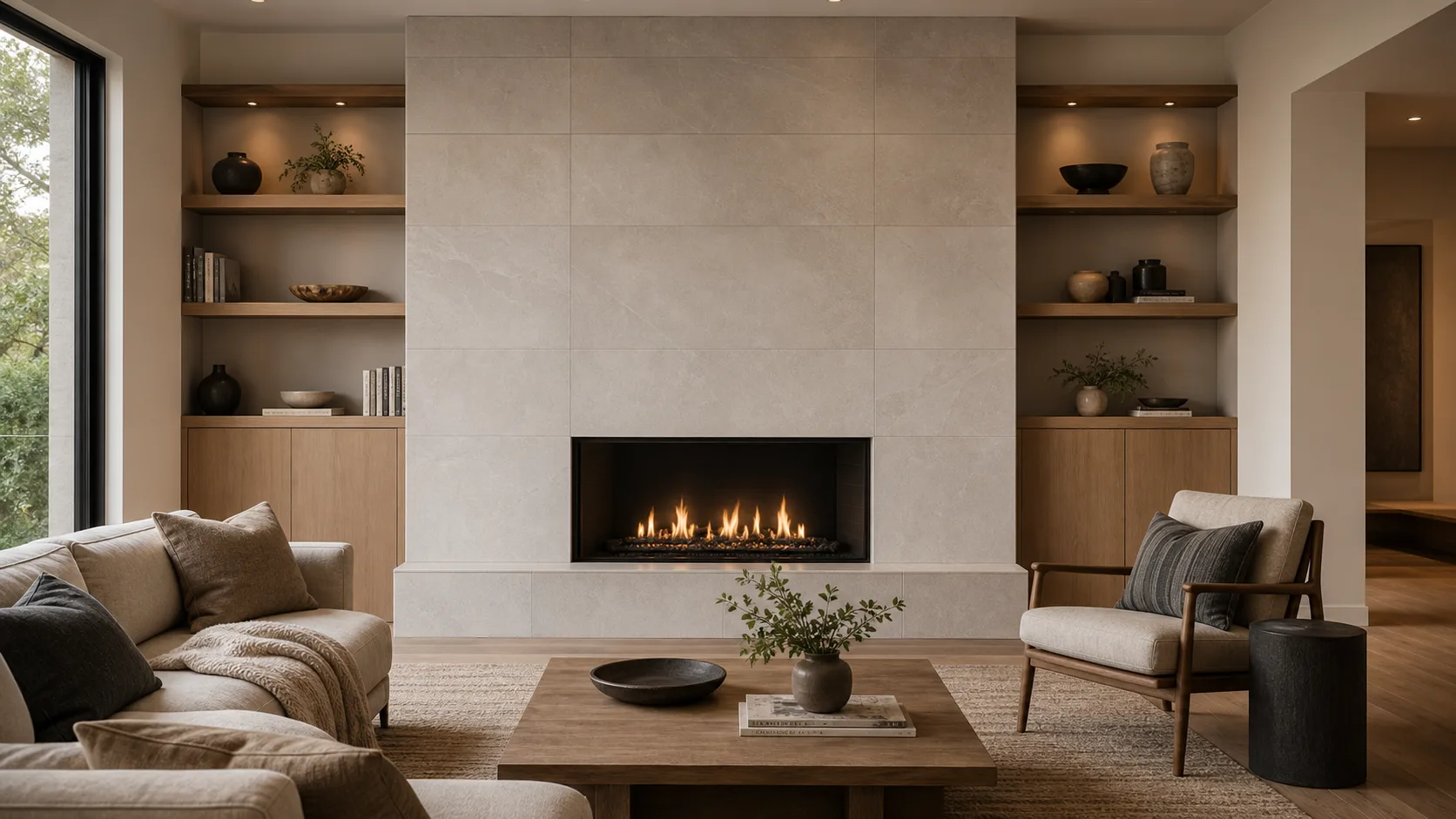
A fireplace is already a natural focal point. The surround should strengthen its proportion and connect it to the room—not overwhelm the firebox with unrelated pattern, joints, shelves, screens, and accessories.
Choose the Right Architectural Proportion
A compact surround frames the opening and keeps attention low in the room. Full-height tile turns the fireplace into an architectural wall and can make the ceiling feel taller. A wider composition may connect built-ins, windows, or seating—but needs enough visual breathing room.
| Approach | Visual effect | Planning focus |
|---|---|---|
| Opening surround | Quiet, contained frame | Balanced border widths and clean corners |
| Floor to mantel | Traditional horizontal emphasis | Mantel, hearth, trim, and combustible clearances |
| Floor to ceiling | Strong architectural feature | Joint mapping, ceiling cut, handling, and movement |
| Wide feature wall | Connects fireplace to the room | Relationship to shelves, seating, doors, and screens |
Let the Material Support the Mood
Stone-look porcelain creates a calm architectural surface. Concrete interpretations feel quieter and more contemporary. Wood-look tile adds warmth visually, though its appearance does not make it combustible wood. Decorative or small-format tile brings rhythm and craft, while large formats reduce joint activity.
Choose one leader. If the tile has dramatic movement, keep the mantel and furnishings restrained. If the room already contains strong art, shelving, or views, a quieter surround may be more effective.
Map the Tile Around the Opening
The firebox makes small layout mistakes easy to see. Draw the opening, hearth, corners, ceiling, joints, and tile dimensions together before installation. Avoid accidental slivers at the sides or top, and decide whether joints align with the opening, centerline, mantel, or surrounding architecture.
Veining and directional graphics should be previewed across the full wall. Several attractive individual pieces may form an unbalanced composition when installed together.
Resolve Edges, Returns, and the Hearth
- Select finished edges, compatible profiles, miters, returns, or framed transitions before ordering.
- Coordinate tile thickness with the firebox trim and adjacent wall finish.
- Plan outside corners and exposed sides from normal viewing angles.
- Confirm whether the hearth is flush, raised, projecting, or part of another required assembly.
- Keep grout, sealants, movement accommodation, and cleaning access in the detail.
For related advice on creating a controlled focal surface, read Feature Walls →
Tile Is a Finish—Not a Clearance Solution
Fireplaces may be masonry, factory-built, gas, electric, or solid-fuel systems, and their requirements are not interchangeable. Porcelain tile around an opening does not make nearby combustible framing, mantels, televisions, shelves, or wall assemblies automatically acceptable.
Follow the exact fireplace listing and installation instructions, adopted code, required noncombustible construction, clearances, hearth provisions, ventilation, and local approval. The substrate, setting materials, profiles, sealants, and adjacent finishes must also be suitable for the expected conditions. Decorative porcelain should never be assumed suitable inside the firebox.
Common Questions
Can porcelain tile be used around a fireplace?
Possibly, but the fireplace type, listing, location, substrate, setting materials, heat, instructions, and code must support it.
Should tile extend to the ceiling?
Full height creates a stronger feature; a lower surround can feel quieter and better suit some rooms.
Can tile go inside the firebox?
Do not assume so. Firebox materials are specialized and must follow the approved fireplace assembly.
Is a tiled hearth always required?
Requirements vary. The tile design follows the required assembly; it does not determine it.
What edge detail works best?
Finished edges, compatible profiles, miters, returns, or framed transitions can work when planned in advance.
Can a television or wood mantel go above it?
Only after clearances, heat, listing, instructions, code, and mounting details are confirmed. Tile does not cancel them.