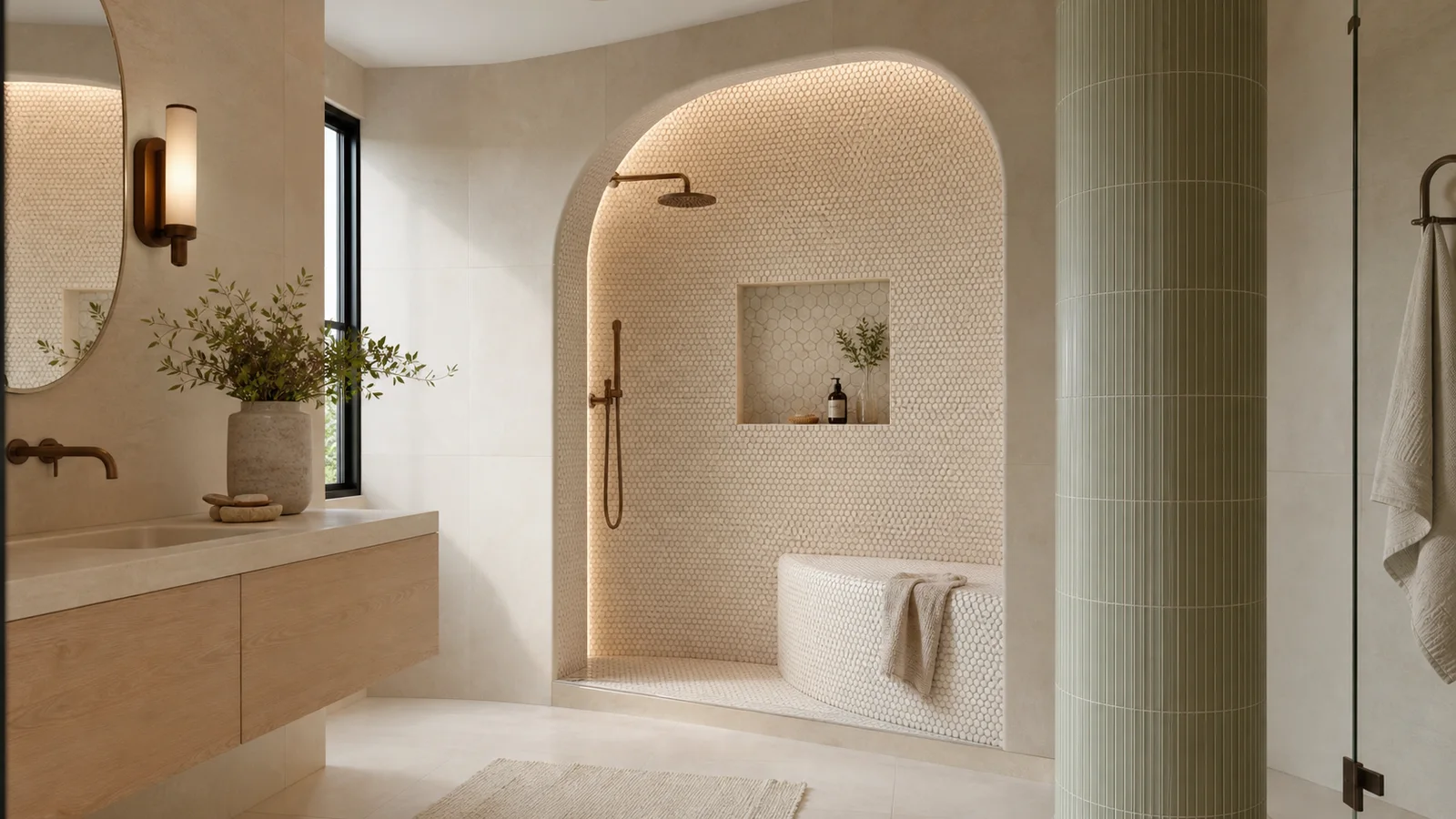
Curved architecture needs a surface that can follow it without looking forced. Small mosaics create that flexibility through many individual pieces and joints—but the shape, orientation, sheet, radius, and grout rhythm must work together.
Why Small Pieces Follow Curves
A rigid tile remains flat. A mosaic sheet bends because the joints between small pieces act like hinges. Smaller pieces and more joints usually allow greater flexibility, but the backing and orientation can limit movement.
Match the Shape to the Form
| Shape | Visual effect | Curved-surface consideration |
|---|---|---|
| Penny round | Soft, continuous, playful | Many small joints can follow compound curves |
| Small square | Classic grid | Flexible, but alignment reveals distortion quickly |
| Hexagon | Geometric with softer transitions | Good flexibility; perimeter cuts require planning |
| Kit-kat / finger | Strong linear rhythm | Orient narrow pieces with the direction of the curve |
| Irregular mosaic | Organic and less gridded | Can disguise transitions, but joint consistency still matters |
Radius and Direction Decide What Works
A broad column may accept larger pieces than a tight arch return. Convex and concave curves behave differently, and a compound curve is more demanding than a simple cylinder. Never force rigid pieces to bend.
Long mosaics can wrap when their narrow dimension crosses the curve; rotate them and they may resist it. Confirm orientation before finalizing the pattern.
Hide the Sheet, Preserve the Rhythm
- Dry-lay several sheets together.
- Match spacing between sheets to spacing within each sheet.
- Stagger or interlock sheets only when designed to do so.
- Cut backing and reposition individual pieces around transitions.
- Inspect under the final lighting before mortar cures.
Plan Where the Curve Begins and Ends
Transitions to flat tile, painted walls, glass, benches, niches, floors, and ceilings should land at clear architectural boundaries. Exposed edges need a planned trim, profile, finished piece, miter, or another approved detail.
For material selection, read Choosing Shower Mosaic Tile →
Common Questions
Can any mosaic follow a curve?
No. Piece size, shape, mounting, thickness, radius, substrate, and application all matter. Test the actual sheet.
Which shape works on a tight curve?
Smaller pieces usually conform more easily. Orientation is especially important with long narrow mosaics.
Why are sheet lines visible?
Spacing differs between and within sheets, or lighting reveals the grid. Dry-lay and adjust individual pieces.
Can large tile be bent?
Standard rigid tile should not be forced to bend. Use appropriate small pieces or a purpose-designed system.
Should grout match?
A close match emphasizes form; contrast emphasizes every piece and spacing difference.
Do mosaics waterproof a curved shower?
No. They are the finish over a complete compatible waterproofed assembly.